
The Flash: 314 “Attack on Central City” Review
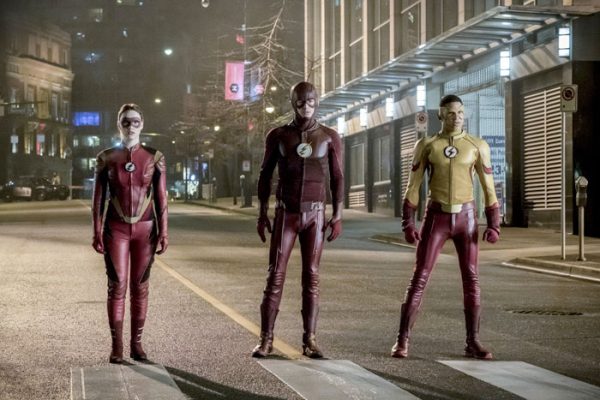
Reviewed by Louis Rabinowitz.
Last week, The Flash took a trip to Gorilla City to tackle both Grodd and Solovar. The results were exciting, but a little restrained given the incessant promotion of a ‘two-part event’. But we’re not done with Grodd yet, as Attack on Gorilla City ended with his army of gorillas ready to invade Earth-2. So with that tantalising cliffhanger to launch us into the conclusion, did the attack on Central City bring this brief arc to a satisfying pay-off?
Funnily enough, Attack on Central City is a character drama in gorilla’s clothing. The CGI bonanza promised by the cliffhanger last week barely materialises as it’s left to a brief scrap in the final act, and the city is left almost entirely intact apart from a few smashed windows in one building. Rather than repeating the boundary-pushing spectacle that the trailers trumpeted, this Gorilla City two-parter has ultimately been a catalyst for Barry to reconsider and reaffirm his worldview. That’s a surprising choice, and in a lot of good ways too. I’d be lying, however, if I said I wasn’t left a little shortchanged by the relative lack of action. The Flash finds a lot of clever ways to work around Grodd, but it never seems to fully come to grips with the scope of the threat that the army proposes, which lies quite a long way outside this show’s budget-limited grasp. It is, however, still a solid effort that exemplifies The Flash’s rehabilitation of Barry Allen as a character in season three, and which illustrates an admirable balancing act with an ensemble that’s never been bigger than it is here. That, and we get a cameo from Earth-19’s Flash, the Accelerated Man to enjoy. It’s not all substantial.
Attack on Central City builds on an idea proposed in last week’s episode that never really took root, which is Barry’s unwillingness to kill. Instead of a tangential idea grafted onto a story that didn’t have the time for moral ambiguity, Barry’s no-kill rule is front and centre here, and the increased focus allows it to serve a much clearer purpose. In essence, Barry’s conflict is the classic hero’s dilemma of weighing up moral purity against brutal effectiveness. Grodd works well as a frame for this dilemma because he’s a genuine sore spot for Barry as one of the most powerful villains that he’s faced, and one that keeps coming back with his appetite for bloodshed only strengthened in his absence – their long history is key to rationalising Barry’s temptation to take the easy route of killing him, which wouldn’t work with a less-established foe. Furthermore, it allows Barry’s optimism and resourcefulness to come to the fore as it did last week, affirmed as an indispensable part of The Flash’s appeal. It’s refreshing to see the brooding ‘ends justify the means’ approach rebuked so clearly in favour of Barry’s steadfast refusal to compromise his morals, which reminds us of the innocent goodness that distinguished Barry so easily from Oliver Queen in the first place. Yet he’s not allowed to be perfect here even as the best parts of his character are held up. A particularly good moment here is Iris reprimanding Barry for making moral compromises that use her impending death as justification, reminding us of Barry’s frequent ability to forget that the impetus lies on him alone to forge a better way for things instead of making easy excuses. It’s the most balanced portrayal of the character so far this season, true to his experienced status as a leader of his own small team of speedsters but also aware of how he’s still tethered to the uncertain, good-hearted novice of season one, for better and for worse.
Barry’s essential dilemma of compromise versus integrity has been done before, but Attack on Central City provides a new spin on it by placing Barry in the midst of the glut of new heroes that have cropped up this year. His conflicts aren’t just internal – they now affect a huge number of people, which requires him to lead by example and act as a symbol of his own values. That’s an idea that’s best conveyed in his appeal to Solovar as he holds Grodd hostage after their battle and prepares to kill him, only for Barry to appeal against. It clarifies Barry’s integrity by pointing out that his heroism is meant to be an inspiration to others – it demands better as opposed to letting everyone else play by their own rules, an approach that’s seen on Arrow where every member of the team seems to have a different policy towards taking life. In essence, it’s not just about Barry anymore, and therefore the emotional stakes of his moral struggles and the significance of his heroism as something that can inspire a city are therefore higher than they have been before,
With such an expansive cast of characters gathered together, there was bound to be plenty of fun interplay in Attack on Central City, and it certainly delivers. Last week saw three separate Cavanagh performances, and this week we’re treated to HR and Harry sharing the screen for almost the entire episode. It’s a strong episode for both versions of Wells, as their proximity forces The Flash to make a case for the value that HR and Harry bring to the team that the other cannot match. While both men are painted in a flawed light here, they’re only pitted against each other in a friendly manner with an eventual undercurrent of respect emerging at the fact that neither is really better than the other and both have their own purpose in the team. It’s all the more impressive, of course, because they’re being played by the same guy. The visual distinction of Harry’s glasses is barely needed here, with Cavanagh bringing out the endearing individuality and contrasts of HR and Harry with varying cadence and demeanour, ensuring that their shared face feels nothing more than a fun little quirk that adds a comic edge to their interplay. While Harry heads back to Earth-2 at the end here, I would be surprised if The Flash was done with inter-Wells interplay for the season. They’re too fun together to separate for long.
Attack on Central City also followed up on last week’s most difficult loose end, which was Wally and Jesse’s relationship. The inherent problems in their pairing still remain. Jesse is too insular a character, defined only by her narrow existence as we’ve seen it portrayed on screen without proof of a vibrant life that exists outside of it, to be paired off with Wally at this point in her development. And the brief drama of Harry lying to Wally about his supposed terminal illness is a puzzling one that paints Harry in an extremely distasteful light that’s not really picked up on again, even if it serves as a way to illustrate the very real roadblocks that exist to a relationship that’s (ahem) speeding forward without ever looking back. Nonetheless, it’s good to see The Flash take the best option it could with the mistakes it’s made, and commit to Jesse as a regular presence who’s sticking around on Earth-1. It ensures that all of the drama of the last two episodes serves a greater purpose than just giving Jesse and Wally something to do outside their career as speedsters. When things start getting perilous again with Savitar back, there’s at least been some emotional groundwork, however haphazard, laid in order to add stakes to the inevitable threats that their relationship will face.
It essentially proves that the Jesse/Wally problems aren’t to do with the concept, but the execution. Their pairing makes sense as the two junior speedsters, and Violett Beane and Keiynan Lonsdale make a likeable couple this week, relaxing into the ease of an early relationship in a way that’s more convinncing than their angst-ridden conflict last week. As I mentioned last week, having a secondary ‘fun’ pairing to contrast Barry and Iris is a good idea that offers up a greater variation of character drama to play with in the coming weeks. The Flash will now have to use Jesse’s time on Earth-1, however long it lasts, to make this good concept work in practice, and slowing down to flesh out what they mean to one another wouldn’t go amiss in that regard.
Onto the gorillas, then. Attack on Central City never had a chance of delivering on fan expectations of a huge brawl between gorillas and speedsters, and it was a bit too much for the show to try. It’s really fun that The Flash is trying to do conflicts on a scale as large at this, but it needs to know its limits and recognise that some of the craziest comic book ideas are outside its budgetary grasp and can’t be realised in a way that does justice to the concept. As a result, the gorilla army doesn’t really work. They’re a faceless force with no identity that never participate in the action, bowing before Grodd and then Solovar quite easily, and the brief battle with them is frustratingly limited, evidently constrained from portraying the extent of their scope. Likewise, the nuclear threat is a bit of a bust too – it’s a huge threat for The Flash to throw in as a brief distraction before the final act begins, and again, this show’s limits means it boils down to a visually underwhelming resolution of Barry pressing a lot of buttons very fast.
Attack on Central City isn’t without a good understanding of threat. For instance, Grodd’s psychological attacks, manipulating Joe into shooting himself in the head, are a genuinely imposing obstacle for Barry that brings home just how Grodd can get under his skin and how his animalistic nature makes him impossible to reason with, all without actually showing the gorilla. The final fight between Grodd and Solovar, even if it is brief, is also a very impressive one visually – it finds that video game cutscene fluidity of last week’s arena fight and foregrounds the emotional immediacy of their conflict even as we’re seeing two CGI creations battle it out. As a small taster of how this episode could have been with a bigger budget, it’s a memorable one, and Attack on Central City packs in as much spectacle as it can within those couple of minutes. It’s not a disastrous execution of the concept, but the ineffectiveness of the army threat shows how The Flash is ill-suited to these kind of expansive battle royales as it simply can’t do them justice (see also: Zoom’s army from last season). If Grodd comes back, The Flash would do well to focus more intimately on the individual threat he imposes, doing what it can within its limits. Or go for a Grodd versus King Shark fight now they’re locked up in the same place. Either works.
We’re left with not one but two big cliffhangers here. The first is emotional, as Barry, galvanised by the defeat of the gorilla army, pops the question to Iris in their apartment in a sign of how he wishes to live in the present. It’s an intriguing bit of accelerated storytelling, showing the very real impacts of the ticking clock that the vision of Iris’ death brought about. Barry’s trying to compress their life together down despite the fact that they have not been together for long, and it’ll be interesting to see just how that pans out. At the very least, there’s now one more big reason as to why Iris’ death would completely upend things. Cliffhanger number two, meanwhile, is more abrupt: on a run to nab some fast food, Wally suddenly finds himself confronted with Savitar, who sprints at Wally as we smash to black. This is going to end well for everybody.
Rating: 8/10
Attack on Central City is a surprisingly introspective conclusion to the Grodd storyline that empathetically reaffirms Barry as a morally upright hero and an inspiration to others while deepening some relationships further, even as it proves that The Flash overreached in establishing a threat it couldn’t portray properly. The Gorilla City arc proved to be few of the things we expected, and good at many of the things we didn’t expect.


