
Arrow: 515 “Fighting Fire with Fire” Review
Reviewed by Louis Rabinowitz.
Episode fifteen has always been a major milestone for Arrow in each of its seasons so far. It marks the turning point between the standalone episodes of midseason and the beginnings of the drive towards the season’s endgame. In seasons past, it’s seen the return to Slade Wilson to Oliver’s life, Ra’s al Ghul’s request to Oliver and the first defeat of Damien Dahrk with the help of Vixen. As Arrow begins to round the corner after a slow 2017 this far, did this week’s episode step up the gas?
If you came into Fighting Fire with Fire thirsting for big twists, I doubt you’d be disappointed. It offers two huge, genuinely game-changing revelations in the form of Prometheus’ identity and Oliver’s vilification of the Green Arrow, and in doing so successfully changes the course of the season from its recent meandering. How these twists are executed, and how they’re built up and followed up from, is a more complicated matter. Fighting Fire with Fire is very good at the macro of it all – the kind of episode that looks fantastic on a Wikipedia summary with the plot points laid out – and offers some interesting character development, but it often comes unstuck in the miniature of character motivations and fluent pacing, torn between offering moral ambiguity and dictating to the audience. It’s a step up from the last couple of episodes, and it contains about ten times the amount of consequential developments, but the issues that have plagued Arrow since the mid-season break aren’t going away any time soon.
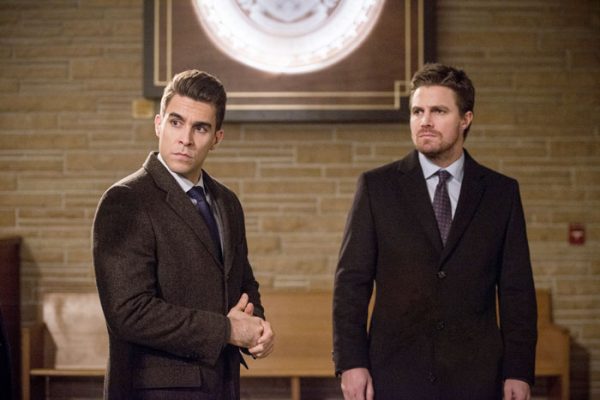
First, there’s the elephant in the room. I fully expected Fighting Fire with Fire to be a full Vigilante story to delay the inevitable Prometheus twists a little more, but the episode is quick to refute that assumption. Initially, it seems like Prometheus only gets a cameo here, but he’s actually in the episode all the time. That’s right, he’s none other than District Attorney Adrian Chase, who graduated this episode to Oliver’s friend, just in case you needed more dramatic irony. It’s always difficult to do justice to a reveal that was cooking for this long, subject to a legion of fan theories, but credit where credit is due: this is the best choice Arrow could realistically have made with what it has at its disposal. Cleverly, Arrow managed to obfuscate the fact that Adrian was the most obvious candidate for Prometheus by winking constantly at his comics alter ego of Vigilante – the first act of this episode, in particular, is absolutely filled with misdirects of that kind. It’s the kind of smart manipulation of the source material to play with fan expectations that Arrow should do – conscious of to the legacy of the comics while offering up genuine surprises for the entire audience.
That being said, the actual reveal is executed with surprising clumsiness. Prometheus is jammed into an episode that doesn’t have much to do with his villainous alter-ego, appearing halfway through for a fight scene that’s completely isolated from the rest of the narrative (Adrian’s police report, for instance, doesn’t come up again) and then unmasking himself in a way that’s entirely without foreshadowing. Even when The Flash tacked its Zoom reveal onto an unrelated episode last season, it made sure to make the reveal into a cliffhanger so the impact of it could sit with the audience. Fighting Fire with Fire just throws the reveal in and gets on with its business, barely stopping to note the newfound dramatic irony of Oliver and Adrian’s dynamic until the final scene resumes his threat. It doesn’t distract from the fact that this was a fundamentally well-conceived twist that promises an exciting endgame ahead (Josh Segarra has always been at his best playing the more unhinged side of Chase, so I have no doubt he’ll be great as a proper villain) but its impact is certainly blunted by its abruptness and tangential relationship to the rest of the episode.
Moving on from Prometheus, Fighting Fire with Fire’s main conflict centres around the threat of Oliver’s impeachment after the revelation of his cover-up of Malone’s death. Arrow has become more proficient at emphasising the duality of Oliver’s heroism, as the inspirational leader figure in public and the blunt force vigilante in the dark, and this episode has a strong handle on that essential contrast, providing a conflict in which both sides are directly opposed. The choice to bench Oliver as the Green Arrow in the fight against Vigilante is a smart one, splitting his two functions and allowing Arrow to illustrate how unified his team have become even in his absence, carrying out Oliver’s mission with brutal effectiveness almost as if they were extensions of him. It also means Arrow is able to foreground some of the supporting characters on Team Arrow in their own subplot – Curtis’ development of his T-Spheres is a very fun step towards his comic book incarnation that gets a lot more emotional grounding and focus than it could have done if Oliver were involved in this story. The greatest success of making Oliver the mayor, even with all the badly-conceived politics, is that Arrow no longer needs to involve Oliver in everything to make for compelling conflicts – it can simply continue on its themes with him in the public eye. It means the episode can split itself between politics and traditional action seamlessly without ever tripping over itself, which makes for a particularly exhilarating final act.
Oliver’s own travails are emblematic of the best and worst instincts of this episode. While the threat of the impeachment initially feels thinly-sketched and lacking in urgency, Arrow finds a way to give it gravitas by ensuring that evading the situation comes with genuinely significant consequences. Oliver throwing the Green Arrow under the bus is the kind of twist that makes you sit up with a start, such as it upends everything that Arrow has established this year with Oliver’s rapprochement with the police of Star City. Immediately, the consequences of this for the rest of the season are really significant, offering up a whole new obstacle for the team to reckon with that livens up their conflict against Prometheus intriguingly. Going back to that idea of duality, this twist offers up a fascinating suggestion about Oliver, which is that one of the vicious cycles he’s trapped in is the tendency to shut off one side of himself to allow the other to thrive under the belief that he can fundamentally separate himself. We’ve seen Oliver take these drastic decisions time and time again, from his brief retirement as the Arrow to his retreat from the public eye, so bringing back this aspect of his character is a smart choice in a season that’s aiming to bring his tumultuous emotional struggles full circle and make him into a fully-fledged hero. It might seem repetitive, but Arrow has done well at reviving old conflicts and updating them with a new perspective in Oliver’s story arc this year. There’s no reason it can’t do the same here.
On the other hand, there are some real problems below the surface here, especially in the build-up to this twist with Oliver. One thing that this season shown is that Arrow is at its best when it challenges Oliver Queen’s point of view. He’s always been a mess of a character, and there’s real value in exploring his contradictions, for instance in his attitudes to lethal force. Fighting Fire with Fire instead chooses to place Oliver as a moral beacon here who lectures Felicity and Thea about their behaviour and pursues a relationship that we’re invited to believe is an entirely good thing. It’s an ill-fitting function for his character, who doesn’t suit moral righteousness considering how much of his story centres around moral compromise and creates an overly didactic approach where Oliver’s unchallenged views on characters become the episode’s views with little room for debate. We see everything through Oliver’s eyes and are invited to take his stance because the episode doesn’t provide a reason to doubt it (he ends up right on every count), and that means that, like last episode, the moral conflicts here that Oliver makes judgements on are quite simplistic and one-sided, with very little doubt as to what the consequences of them will be.
Those moral conflicts are faced by Thea and Felicity as they contemplate brute-force solutions to their problems. Like most plotlines in this episode, they’re good but notably flawed. Thea’s story is a genuinely compelling one for the most part, charting her descent into increasingly opportunistic and manipulative behaviour as her suggestions escalate in coldness, but the episode is too quick to unequivocally condemn her behaviour. It robs this episode of a chance for a real, balanced debate on this kind of dirty politics for a greater good, and puts a time limit on her character arc by quickly establishing her position as a kind of moral rock bottom from which she can’t go any deeper. Therefore, Thea checks out of the mayor’s office by the end of the episode, and she’s left without a single function in the show. What we do get before this abrupt conclusion is very engaging and morally challenging drama, but Arrow’s rushed approach means that the potential for a slower and more ambiguous descent into amorality is scuppered before her story can even really begin.
Felicity’s, much like Thea’s, is best in the build-up. It’s one of the rare examples where Fighting Fire with Fire sets up a legitimate debate, partly because Felicity is contrasted not with Oliver, but with the sager and more stable Diggle who acts far better as a moral compass. Felicity’s temptation by the power of a weapon that allows her to, as she sees it, adapt a little of the darkness she’s seen her friends use is credible in the aftermath of the trauma of seeing Prometheus manipulate her happiness away, and it’s a nice example of Arrow meaningfully evolving her character in a way that’s true to her initial conception as an empathetic hacker, free of any romantic entanglements with Oliver (other than a terrible scene where Oliver asks her for help with his lovelife, which, ouch). However, the conclusion of her story is a jarring one, tenuously finding a basis in the narrative despite the entire episode pointing away from her moral descent. There’s value in surprise, but an abrupt U-turn to continue a story beyond a perfectly reasonable endpoint is a particularly clumsy twist that moves into potentially intriguing new material with an awkward pivot.
Remember Adrian Chase? Well, he’s evidently pushing his plan into a high gear by confronting Oliver’s journalist girlfriend Susan with a ‘life or death’ exclusive in a way that completely lacks suspicion and seems entirely legitimate. I like how Arrow is quickly pulling the trigger on Adrian being more open in his villainy now that we know, which prevents a long, drawn-out game of dramatic irony that we’ve already seen played out on The Flash. The acceleration in storytelling is welcome, but the cliffhanger finds difficulty in making us worried for Susan. Arrow has invited us to think of her as a legitimate romantic interest for Oliver and a victim of misguided treatment from Thea and Felicity, but she’s too flat, too well-established in her moral ambiguity beforehand to slot easily into this new role of confidante. Pushing her into the role of damsel in distress, in of itself a creaky and sexist cliché, is unlikely to alleviate those problems.
Fighting Fire with Fire is an exciting and revelatory episode in the classic Arrow mould of those aforementioned turning point instalments, setting up a compelling new story for the final third of episodes in the season with Prometheus unmasked and the Green Arrow demonised. But Arrow has had trouble translating its lofty ambitions into solid execution lately, and this episode is no different. It’s morally confused, encouraging the audience to take a viewpoint of a character defined by questionable decision-making on matters that at least require some debate, and clumsy in pacing, muffling the Prometheus reveal by placing it midway through the episode with no build-up and cutting off Thea’s developing story just as it was beginning to become something fascinating. Fighting Fire with Fire puts a lot of gas in the tank, at the very least, upping the stakes and urgency of the season no end for when the show returns in a fortnight. If it’s part of a gradual upswing in pace and quality as opposed to a huge step up, then there’s reason to be optimistic.
Rating: 7/10


