
Black Mirror: 305 “Men Against Fire” Review
Reviewed by Ryan Monty.
(This review continues spoilers. Read on if that doesn’t bother you!)
War is hell. People suffer, innocent folk die by the millions. War in general is not a very nice thing indeed. Still though, any war would be instantly favourable compared to the tragedy of war we see in Black Mirror series 3’s penultimate episode, Men Against Fire. Sharing a title with the 1947 book regarding a study of World War II, wherein lay fascinating (though disputed) figures about the fact that most soldiers on the field of battle were unwilling to “shoot to kill”, not even when faced with their own mortal fate. From here, Black Mirror provides us with perhaps the most terrifying premise it has handed us thus far on a scale of all humanity – what happens when the perfect technology to enable the government and armed forces to commit guilt-free genocide is created? We may not be in the startlingly “now” worlds of The National Anthem or Shut Up and Dance, but we are in a world that seems only a step or two from reality.
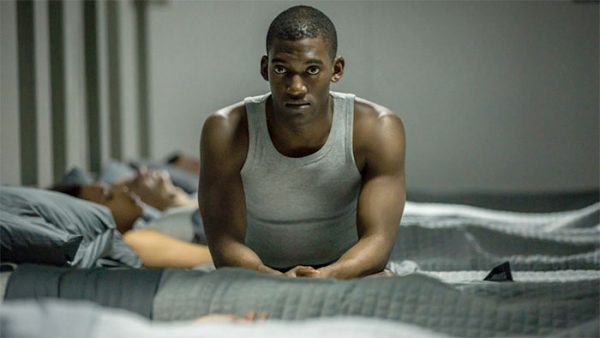
Our vessel into this world is Stripe (played by Malachi Kirby), an ordinary grunt who begins the episode about to head out on his first Roach hunt. He’s a passionate soldier with a dialled back charisma, happy to get on with what he’s doing. His personality is overshadowed by his stern, assured commanding officer (Sarah Snook, who is simply brilliant in Predestination) and his platoon mate Ray, Orange is the New Black star Madeleine Brewer, who is almost unhinged and decidedly trigger-happy as she consistently looks on edge, desperate to get some action, with more than a few shades of Aliens’ Vasquez – forthright and totally confident in her abilities. She’s a blast to spend time in the company of, but also quite disturbing in her perverse attitude.
Director Jakob Verbruggen (who has helmed various House of Cards, London Spy and The Fall episodes) brings us, feet on the ground, into a warzone, complete with all the clichés we’re used to by now – training, military dialogues and all the trappings that come with the genre. We’re fighting this war in a grey, almost lifeless Eastern European seeming setting, where the local villagers live in constant fear from raids of Roaches, to the point that they won’t even touch their remaining food supplies after some Roaches break in. The dialogue surrounding the Roaches instantly leads you to believe they are some inhuman abomination, and when we eventually see them, they are – pale white skin and snarling teeth, reminiscent of the inhumans from I Am Legend. Of course, this is Black Mirror, and telling a straight zombie tale just isn’t how this works – the Roaches are impoverished, totally normal people, who have been targeted by the technology of the piece – the MASS system. The system is a high-tech implant given to all the soldiers, giving them essentially the GPS HUD you’ve seen on every first-person shooter ever, and letting them be the most efficient killer they can be. The more Roach kills you get the better, because every night the soldiers are given their sexual fantasies directly uploaded into their dreams, as their good-job reward for their hunting.
In an episode with heavy themes of mass genocide and eugenics, the idea of killing rewarded with sexual gratification somehow manages to be one of the most powerful concepts. Soldiers here are visibly frustrated when missing out on kills, knowing they’ll miss out on a lurid fantasy during the night. Ray is desperate to get a sizeable number of kills so she can “come all night”, a statement she comes out with while grabbing her crotch for effect. The episode makes it appears the soldiers aren’t allowed any sexual release at all unless they get kills. It’s an unnerving concept that manages to make the horrors of war seem like something more than worth going through, especially since most of the “horrors” aren’t there – the MASS system dulls the senses of the soldiers, from smell to hearing, so they can focus entirely on the rabid monsters they must extinguish. They’re efficient and lethal, with little chance of PTSD. Is this too far-fetched a concept to possibly be implemented one day? After all, “It’s easier to shoot, when you are shooting at the Bogeyman”.
The issues and themes on show in Men Against Fire are perhaps more prescient than ever, especially with modern day media all too happy to refer to immigrants in terms of a “swarm”, and detestable human hatemonger Katie Hopkins even referring to migrants as “cockroaches”. It makes the use of the word Roaches in this episode more effective and prescient – totally dehumanising “them” as not being “us” and being subhuman. It’s present in Stripe’s first meeting with Michael Kelly’s Arquette, where Stripe refers to his second kill of his first hunting session as a “he”, but when questioned by Arquette he soon modifies his language to “it”. And seeing just how terrified the citizens the soldiers are “protecting” are of Roaches, it indicates all kinds of possibilities to just how indoctrinated they are to the events unfolding, or how much propaganda they’ve been exposed to. It’s uncomfortably close to reality. The idea of a eugenics war, where all “undesirable” traits and disabilities are hunted and extinguished in parallel to previous real wars, is genuinely horrifying. With genetic modification and ideas of the future of combat evolving, the possibility of these ideas actualizing once more and the idea of a Hitler-like Aryan race rearing its head again to wipe out those who are “lesser” become greater.
The star of the show here though is indeed Michael Kelly. As the episode reaches its rapid climax, Stripe is held in a bleached white room after he discovers the nightmarish truth about MASS – where Kelly’s Arquette lays out – in frighteningly rational, understandable terms – why the unspeakably horrific genocide occurring is happening. It’s powerful and disquieting in the best way – Kelly’s tone of voice rarely raises, and contrasted with Stripe’s awful sense of slow realisation it creates an expertly-crafted scene. The choice Stripe is given is an impossible one- live out his days in military prison, forced to replay his “heroic” actions from the Roach hunt over and over in his head, or wipe his memory of the events and return to service? It’s a gutting scene, with Kirby’s previously seemingly unshakeable Stripe letting loose in a torrent of torment and emotion, leading up to an immensely powerful ending wherein Stripe is honourably discharged to his military retirement, fantasising a beautiful house and wife while he stands, single tear falling down his cheek, staring at a dilapidated house.
While Men Against Fire isn’t the most inventive or fresh episode of the series within the trappings of the war genre, it can easily stand up proudly as a piece that addresses concerns that are becoming worryingly prescient in the public sphere as the “us-vs-them” narrative whips into a frenzy and is infused with unbelievable levels of hatred. While some of the ideas on show may seem too far-fetched to be ever accepted in the future, the past has all too often shown us that the future may just be even more horrifying than what has come before
Verdict: 8/10


