
Fargo: 202 “Before the Law” Review
Reviewed by Louis Rabinowitz.
It’s surprising to remember that there was a time that I doubted Fargo. After last week’s strong, quirky premiere that laid out the tangled web of characters and conflicts of season two, Before the Law nips any concerns that season two would fall off after the premiere in the bud. Once again, this is a remarkably assured instalment, adding further and further credence to the idea that Fargo is genuinely one of the strongest shows in the current ‘Golden Age’ of television.
Before the Law is a slow-burner of an episode, more so than last week, but it still ably juggles an ever-swelling cast and numerous subplots with barely a fumble. Last week introduced a thoroughly likeable young version of Lou Solverson, but the premiere perhaps didn’t do quite enough to flesh out the character from the get-go. Here, however, Lou’s character becomes far sharper and more distinct, with every scene featuring the cop organically adding a little more texture. It’s not conventional leading man material, often, with a particularly great scene revealing that Lou leans heavily on his thoroughly ill yet notably astute wife in his police work. It enriches the character, and allows Betsy to become a stronger and more independent figure who’s not solely a comforting housewife, and isn’t entirely defined by her cancer. It’s also a nice piece of foreshadowing for season one, hinting towards Lou’s destiny as a peaceful diner owner removed from the tangled world of Midwestern crime – like Gus Grimly, there’s a sense that perhaps Lou isn’t quite cut out for this.
Another strong facet of Lou’s storyline in Before the Law is how it uses the historical setting to not only deepen his character, but also Hank’s too. Lou’s residual trauma from the Vietnam War is reasonably conventional stuff, but it still does the job in adding a sufficient amount of vulnerability to the unflappably Midwestern cop. What really stands out is the use of the Vietnam War to deepen our understanding of the events of this season – the idea that the spectre of the war still hangs over America ties together a great deal of the violence this season, and makes excellent use of the historical setting for more than just visual tricks.
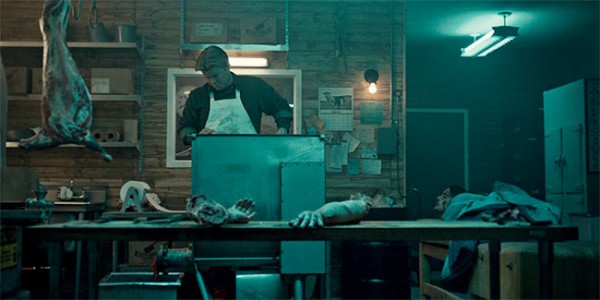
The story of Peggy and Ed, the unassuming murderers, also continues to compel – in particular, it’s Ed who steals most of the spotlight here. He continues to be enjoyable as a bumbling, incompetent murderer whose slip up almost blows his operation entirely when Lou comes to visit, but Before the Law adds several intriguing layers of mystique to the character. At times, when standing on front of the fire burning his bloodstained clothes, Ed looks almost like a naïve, confused child who’s been dumped into a world he can barely comprehend. Yet it’s not quite as simple as that, with Ed’s unsettling, dissonant serenity as he grinds up Rye’s body (a fittingly gruesome visual) perhaps hinting that he’s not quite as naïve as viewers would expect. It fits in perfectly with the central conceit of the murderous lurking within the polished sheen of suburbia, and acts as a neat parallel to the equally nebulous, uncertain Peggy. Are the couple good, unassuming people caught up in a situation they never intended, or are they taking to covering up murder a little too easily? For now, Fargo is playing both sides, and it’s hugely intriguing to watch.
Aside from the continued strengths of the characters introduced in episode one, Before the Law made an excellent new addition – Mike Milligan, part of the syndicate who are tracking down Rye. Bokeem Woodbine’s performance is a true highlight of this episode, making Mike into a thoroughly affable, friendly guy who’ll perform acts of violence with an apologetic smile. His tense conversation with Hank also highlights the subtle undercurrent of malevolence that runs through Woodbine’s performance – Mike may be friendly, but there’s a distinct impression that he could slip at any moment and turn to brutality. Mike’s a tertiary character at best, but every scene with Woodbine is utterly captivating and thoroughly entertaining to watch – he keeps the appeal Lorne Malvo had in season one of the unstable element crashing into ordered Midwestern society, but exists as a unique and entirely different creation entirely.
I praised Fargo’s use of gender politics last week in the Gerhardt storyline, and, thankfully, it’s following through with that. There’s a common theme emerging of strong, yet underestimated woman in all the different corners of season two, but it’s more apparent with Floyd. It’s plain to see that she’s the most capable and level headed person in the family, but she’s pinned back by her misogynistic son, which, cleverly, induces sympathy for someone who’s still a ruthless criminal kingpin. Despite the strong, capable character of Floyd, her storyline is probably the weakest of the episode, thanks to the thin and slightly clichéd character of her son. Fargo’s excelled at adding depth and texture to characters in such a short space of time in season two, so it’s a shame to see that this important character remains an archetype and little else.
As with last week, the direction continues to be fantastic. Even the scene transitions impress, with the constant fades leaving flickers of a very different world and heightening the constant juxtaposition of order and violence that’s emerged as a central theme of the show as a whole. Likewise, it’s the direction that wrings tension out of the climatic scene in the butcher’s. It may look fairly prosaic on paper, but in execution it’s a surprisingly taut, nail-biting scene that ably juxtaposes Ed and Lou’s vastly different perspectives on the meeting; to Ed, as the frantic direction shows, it’s an attempt to desperately swat away a cop, but to Lou it’s an innocent attempt to buy breakfast for his daughter. Ultimately, it also shows just how close Ed was to being caught, underlining his concerning incompetency and heavily indicating that this murderer won’t be able to stay unnoticed by the law for too long…
For an episode filled with mystery and scarce answers, it’s fitting that Before the Law, at least in the US version (the version that aired on Channel 4 was a tad subtler in the ending), ends with another teasingly vague hint of an extraterrestrial presence, with the War of the Worlds monologue alluding to an otherworldly force watching over the events on Earth. It’s surprising to see Fargo commit to aliens as a consistent presence, but it’s certainly not out of character for a show that leaned heavily on Biblical themes in season one. At the moment, this could go either way – it could continue to be an intriguing undercurrent that’s never explained, and is up to the viewer to determine its importance, or it could become too prominent, destroying the viewer’s suspension of disbelief and violating the credibility Fargo has built up. Right now, though, the UFOs remain a satisfyingly ambiguous presence, but they might not stay that way forever…
Rating: 9/10
Before the Law continues Fargo’s confident stride into its sophomore outing by simultaneously becoming more expansive, introducing several new characters, and more intimate, as we get our first real glimpses of the true complexities of the central personalities of this new season.


