
The Flash: 315 “The Wrath of Savitar” Review
Reviewed by Louis Rabinowitz.
The spectre of Savitar, and his date with destiny in murdering Iris West, has been hanging over The Flash like a dark cloud since the mid-season finale, influencing Barry and Wally’s every action, but the hulking speedster villain hasn’t appeared in the flesh/metal for quite some time now, as the show has pursued other villains from Gypsy to Grodd. That all changed quite dramatically this week.
The Wrath of Savitar is a sock to the jaw after weeks of upbeat episodes, blowing up established character dynamics and taking Barry Allen to rock bottom as he’s forced to bear the full brunt of his own poor decision-making. The Flash has been intent, to a fault, on presenting Barry as a thoroughly flawed character who makes bad decisions in the last season or so, but it’s often failed to make these decisions stick by failing to really explain the reasoning behind them, or implicitly condoning the behaviour by offering up no opposition. After the recent episodes have tried to steer away from this portrayal of Barry, The Wrath of Savitar returns to the idea that he can be selfish, impulsive and cruel in order to accomplish its goals, and it paints many of the cast, especially Wally, in the same light. But it’s the first episode to really dig into the psychology behind the mistakes, bringing realism to contrivance. Not every plot point escapes the feeling that a lot of chess pieces are being pushed around here, but it’s a refreshingly insightful and compelling episode as a result of its care in characterisation despite how it possesses all the ingredients of the very worst of The Flash.
The theme of the day was fear – the kind that gets under the skin and overrides any sense of rationality. It fuels every character here to some extent, and The Wrath of Savitar succeeds by always focusing on that process of panic winning over reason, and never presenting character’s decisions as something logical and sensible. The episode’s willingness to tackle the fear that hides behind so-called reason, a much darker theme than The Flash is used to, allows it to really dive into the complexities of stories that haven’t been explored to their fullest extent yet. A key example of this lies with Barry’s relationship with Iris. Ever since Barry’s witnessing of Iris’ future death, there’s been something off about the couple, specifically Barry’s behaviour. Buying a house and proposing might have been heart-warming gestures, but given the short length of their relationship, they made little to no sense as decisions made by a rationally-thinking person. It all seemed a little bit on rails, as if the show just needed to give their relationship a shove forward just so it could accomplish something in the future.
As it turns out, it did, but it’s Barry who’s the one rushing things forward rather than The Flash itself. The dreamlike soft-focus contentment of their relationship might have held up for a happy engagement announcement, but as The Wrath of Savitar is so keen to show, decisions made by fear are doomed to fall apart. What really works about this plotline is that it not only allows Barry’s decision-making to be exposed for the fallaciousness of it all, which papers over some of the cracks that have been accumulating in his relationship story with Iris, but it also provides the chance for Iris to reassert some autonomy. It’s good that Iris doesn’t let Barry off the hook for his decisions and, building upon last week’s encouraging but brief conversation, that she calls him out directly on his paternalistic behaviour that’s overriding anything genuine in their relationship rather than bottling up her feelings, choosing not to be defined as a tragic victim who must be saved. Barry Allen can make some horrible life choices, but that doesn’t preclude him being interesting if the shift from good intentions to damaging execution in his behaviour is examined in depth. The Wrath of Savitar finds the right balance, squaring his season two irrationality with season three’s better grasp on his psyche to take him on a journey all the way down at rock bottom, having learned his lessons about fear in the harshest way imaginable. It’s a punishment for sure, but one that feels like it may be necessary to teach a lesson in the long run.
Playing out in parallel with Barry’s own descent is Wally’s. And wow, it is not a good week for Kid Flash. The Flash has made it abundantly clear before that, below the brash exterior that’s presented to Central City, Wally’s an insecure and anxious young person weighed down by his desperation to prove himself that overrides everything, and those characteristics surfaced to bite him here. Keiynan Lonsdale gets a lot more to play than usual as Wally’s emotional turmoil is foregrounded, and he brings a believable sense of the debilitating fear that’s plaguing Wally and the panic that can easily follow, ensuring that even as Wally succumbs to his worst impulses, we still want him to succeed, making his eventual fate such a cruel twist of the knife. It’s also nice that, in the same way that Barry is challenged despite the team’s respect for his beliefs, the marginalised Wally is proven right in many respects. He quickly notifies the team about Savitar once his visions start becoming a genuine problem, and picks up Barry’s true reasoning for proposing to Iris. His only real mistakes come at the end, so there’s a genuine sense of sympathy for Wally that The Flash creates throughout the episode as he’s portrayed as the helpless victim flailing for answers more than the impulsive kid who makes a crippling mistake.
Wally’s fate, as he’s sucked into the Speed Force to take Savitar’s space, is a conundrum for The Wrath of Savitar. On one hand, it makes good sense as the ultimate consequence of all his unchecked fears and worries rushing into his decision-making. The episode does a good job of tracking the impact of Savitar’s psychological warfare on Wally so we can see him pushed closer to the edge as his greatest worries are exploited – the scene with Wally’s mother appearing first to provide him comfort then to brutally attack his weakest points is an excellently constructed example of this. And it’s hard to deny that Wally disintegrating into the Speed Force, screaming for Barry, hits hard as a cruel injustice and an emblem of Savitar’s ability to find the vulnerable spots in the team and press. The problem is that the decision that gets Wally into this position, picking up a chunk of the Stone to chuck into the Speed Force, barely makes coherent sense as his reasons for doing so, and attitude towards Caitlin for maintaining the piece that he uses, aren’t explained. We can surmise that he wants to finish Savitar off, but the choice to do so in conjunction with the reveal, away from Wally, that Savitar actually needs the Stone, pushes Wally from ‘realistically panicked’ to ‘a little bit dense’, especially given how blatant Savitar’s goading is. His arc works well on the whole, and I’d be fascinated to see how it’ll be followed through when he gets out of the Speed Force, but The Flash’s obsession with the bigger pieces means that it becomes blind to the basic minutiae of internal logic and realistic decision-making in this brief, but important moment.
It’s not just the speedsters who are stricken by fear here either, as Caitlin and Julian both find their greatest fears in the form of their lurking alter egos resurfacing. The reveal that Caitlin kept a piece of the Stone to try and cure her powers is a fundamentally solid one – it neatly mirrors the reflexive actions that Barry and Wally carry out, and Caitlin’s terror of Killer Frost has been established well enough that her desperation to cure it, even if it put people in harm’s way, rings true for her specific emotional state. It’s also a smart choice to continue to deepen her pairing with Julian as his own struggle lends itself thematically to comparisons. Julian’s exploitation at the hands of Savitar is a fascinating part of the character that’s rarely touched upon, so it was good to see The Wrath of Savitar both return to the sinister idea of Julian as the Speed God’s mouthpiece, and to confront the consequences of the trauma it inevitably dredges up. Julian’s fear that he could be a sleeper agent of Savitar without even knowing, mirroring Wally’s worries that his powers were tainted by association, is another example of The Wrath of Savitar picking up an idea that fans had talked about but the show had never acknowledged and integrating it into his motivations. The result is that Julian ends up as a more compelling presence in STAR Labs thanks to the suggestion of his potential volatility under pressure and greater tension between him and Barry as he’s used time and time again as ‘a walkie talkie’/’an Ouija board’. His place in the ever-bloated ensemble seems firmer now, especially as the Savitar arc heats up heading into the season finale.
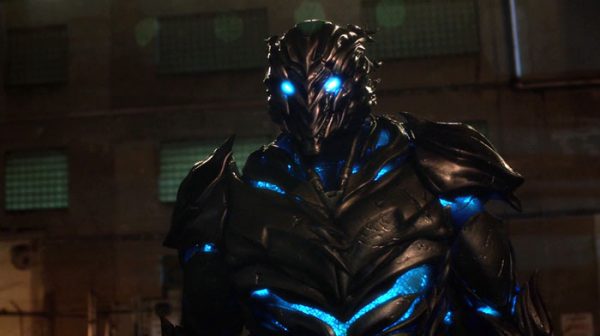
At the core of The Wrath of Savitar, however, is the creator of that fear: the speedster himself. Given how close we are to the season endgame, the onus was on this episode to flesh out Savitar as a genuine and distinctive threat to STAR Labs, and The Wrath of Savitar mostly did a good job. There’s a greater sense of clarity about the role he plays in terms of the season’s themes. As an expert in creating fear who seems to be fuelled by it himself, and a being of monomaniacal anger towards the entirety of STAR Labs with the solemn belief that he’s the bad guys, he’s the inevitable consequence of every bad decision Barry, Wally and co have made. The link to Flashpoint with the reveal of his plan is a smart way to make that apparent, granting Barry a culpability we can latch onto in the present beyond the crimes he’s meant to commit far in the future towards Savitar, granting Barry’s defining mistake a resonance even as its immediate ramifications have been cleared up.
There’s a lot of intrigue despite the satisfyingly concrete answers about his plan. While some of these hints are genuinely stimulating – his constant refrain that he’s the “future, Flash” is perfectly made for debates about syntax, especially as his inextricable link with the two speedsters is better defined, opening up debates about his identity that seem more personal and intimate than the ‘guess who?’ game of seasons one and two. However, for Savitar to stick as a villain, The Flash is going to have to flesh the humanity of him out. What The Wrath of Savitar does in establishing his anger is a good start, but he still doesn’t feel very distinctive compared to, say, Zoom at this point in season two. We need an insight below the mask if we’re to invest in the bombastic proclamations that Savitar is Barry’s greatest enemy and the inevitable consequence of everything he’s done. The Wrath of Savitar suffers from a need to keep its cards close to its chest, creating the suggestion of originality rather than boldly forging ahead with a villain who we know is different to Thawne or Zoom. Savitar has the potential to be fascinating, and it’s always hard to strip a villain of their initial appeal, but he can’t stay at arm’s length as someone who still only seems semi-human forever.
The Wrath of Savitar ends with Team Flash broken apart and Barry finally comprehending the extent of his own mistakes. It’s a dark, dark place to end the episode, but it works as The Flash has kept things breezy and low-stakes for quite some time, making the impact of this sudden tonal descent hit hard. For its basic flaws in sometimes failing to provide specificity to characterisation with Wally and Savitar, The Wrath of Savitar was a very solid way to accelerate the pace by putting pressure on every character until their secrets all burst into the limelight; an intense thriller of an episode despite its heavy focus on dialogue. The Flash has proven that it knows how to execute a series of shocking twists to shake things up time and time again, and this was another example of that skill that maintained season three’s improvements in getting into the heads of these characters and discovering what makes them tick, even in their darkest moments.
Moreover, it tees up next week’s episode in tantalising style. From the promo, Barry’s return trip into the Speed Force to find Wally will dredge up the reverse of last season’s journey. Last time, it was his family and friends that he met on his way to making it out of the Speed Force. This time? It looks like his greatest mistakes in the form of characters dead, alive, or erased out of existence are queuing to have words.
Rating: 8.5/10


