
Gotham: 301 “Better To Reign In Hell…” Review
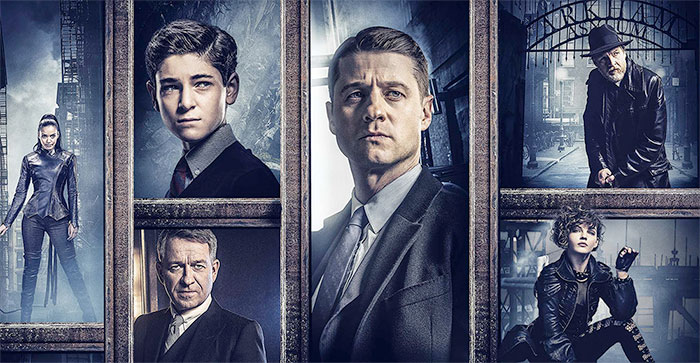
Reviewed by Charlie Pickard.
“Wayne Enterprises revealed itself as morally corrupt. Here, despite the primitive facilities, casual violence, fascistic meathead culture… I love it.”
Gotham’s third season has begun in its usual frenetic style, for better or worse. I largely enjoy the speed at which Gotham races through plotlines, and was pleased with the amount of ground this re-introductory episode covered.
After seeing that Lee Thompkins is with another man, Jim Gordon has returned to Gotham and become an alcohol-reliant bounty hunter, acting like an amoral precursor to Batman. Herein lies the problem, epitomised by this season’s subtitle “Mad City”, that all the elements of a traditional Batman story are present besides the Caped Crusader himself. We have met many of his rogues gallery over the past two seasons, and the show seems tired of waiting for David Mazouz to hit adulthood, so Gordon is now the guy to tackle the Indian Hill escapees.
This was a welcome transition – Gordon has been a straight-laced cop for the majority of the show, so it’s intriguing to see him operating outside of the GCPD. Ben McKenzie seemed to relish the opportunity to play a darker Gordon, and rose to the challenge now that he appears more comfortable in his role. The face he pulled at the end of the cold open when the monster was hit by a truck indicated that Gotham is back: bigger, better and weirder than ever.
The main plot of the episode involved Penguin offering a bounty for anyone who could find Fish Mooney. This was decent but it would have been better had Fish actually met Penguin in this episode. He spoke a lot about her but did nothing of real note. Instead, the people he interacted with were the real winners of this episode.
Cory Michael Smith turned in his usual excellent performance as Edward Nygma in his pithy screen time. His line “Penguins eat fish!” sounded like it was straight from the pages of a comic book. This was a great indication of Gotham embracing its source material and not being as grim as it once was. I think this will be Nygma’s season, once the writers develop him more as a villain as they have with Penguin. Similarly, Erin Richards was in fine form as she portrayed Barbara both as an ersatz damsel and the maniac we now know her as. Her alliance with Tabitha showcases women having as much power and prominence as some of the men on the show, which reflects the great diversity of Gotham’s cast.
I was particularly impressed by David Mazouz, balancing two very different roles. He displayed maturity in the quieter scenes where he had to portray Bruce Wayne as the head of a company about to threaten his own Board. Clad in a suit and silhouetted against a backdrop of skyscrapers, he was reminiscent of the superlative Christian Bale in the Dark Knight trilogy. Mazouz’s subtlety and measured speech provided a good contrast to the more cartoonish elements of the episode. When playing the doppelgänger, he altered his voice and was nothing like his usual character.
Mazouz was supported by the under-used Sean Pertwee as Alfred, who was as reliable as ever. Hopefully he will have a big storyline this season – Pertwee’s undeniable passion for the character has earned it. Elsewhere in the cast, Bullock delivered the funniest lines of the episode, Valerie Vale was a strong new character and Selina Kyle had an unusual alliance with Fish Mooney.
I found the writing of this episode to be good, if not brilliant. All of the stories were new and interesting, but it felt like there were too many vying for attention. Perhaps this episode could have focused on Fish Mooney and reserved the Court of Owls for the next one? Likewise, the show’s protagonist Gordon was merely one cog in a large machine. This led to him seeming somewhat side-lined. However, Gotham is an ensemble piece now, and I’m sure moving forward it will focus on certain characters in different episodes rather than all of them at once; something it excelled at during Season Two.
The plot was functional and set in motion many narrative threads for the season ahead, to the detriment of the current story we were viewing. There was a lot of exposition, understandable for a first episode, and I felt that it would have been tighter had there been one central villain rather than Fish Mooney, the Court of Owls and Hugo Strange’s bat-like creature all competing for screen time.
Nevertheless, the fight scenes with the creature were well-executed and offered a taste of the superhuman for Gotham; this was a big departure from the mob antics of Season One. These scenes were well-directed by series stalwart Danny Cannon: nowhere near the level of the fights in Daredevil or even Arrow, but great by Gotham’s standards.
More praiseworthy was the quality of the cinematography. There was an excellent shot of Gordon watching Lee and her new partner that utilised the frame-within-a-frame shot technique, to emphasise how much of an outsider Jim now is. Another notable shot involved multi-planing, whereby Gordon, Penguin and Butch were all lined up from right to left in the same shot, one behind the other, facing the camera. This provides depth and quality to a shot, and was used in conjunction with razor-sharp dialogue to make Gotham seem all the more comic book-like.
The music was atmospheric throughout the episode, particularly in the montage near the end. It supported the juxtaposition between Jim and Barbara both drinking while in completely different walks of life, showing how much characters change on this show. Barbara is in Jim’s past, the picture of Lee he looks at shows that he still views her as his present, while his romantic chemistry with Valerie Vale perhaps hints at his future?
On another note, the connotations of the episode’s title are fascinating. Derived from Milton’s poem Paradise Lost, they refer to Lucifer choosing to stop serving God as an angel and instead reign as Satan, the Lord of Hell:
“Better to reign in Hell than serve in Heaven.”
My interpretation of this was that it most aptly applied to Jim Gordon. He does not work as a police officer for the GCPD anymore (serving in ‘Heaven’), but is the best bounty hunter in Gotham, a “Mad City” which is an allegory to Hell in this instance. Gordon is seemingly above the law, which symbolises him ‘reigning’ over Gotham as he faces its myriad of villains.
There were some good teases for the rest of the season. Captain Barnes coughing while alone perhaps foreshadowed illness – will Bullock have to replace him again, but permanently? Poison Ivy only being briefly touched by Marv will undoubtedly age her slightly (instead of into a fossil), allowing her new actress to take the reins; a situation which has garnered a lot of controversy. The Court of Owls are pulling the strings behind everything, while Bruce Wayne’s doppelgänger remains an unknown entity.
The climax of the episode was fantastic. Alfred had a good fight scene with the Talon, who defeated him and then kidnapped Bruce, despite their orders being to kill him. This tantalising cliff-hanger certainly made me want to watch the next episode.
Verdict: 7/10
Overall, this was a good re-introduction to Gotham, but certainly not its pinnacle. The cast were solid and the plot was functional. Now that the groundwork is laid, Gotham is free to run and reach new heights.


