
Doctor Who: “Twice Upon A Time” Review
Reviewed by Ryan Monty.
(This review continues spoilers. Read on if that doesn’t bother you!)
It feels like no time at all since Peter Capaldi erupted from the TARDIS to tell Strax to shut up in his first full episode Deep Breath, demanding everyone took five, collapsing to the ground. Through paranoid trips into the nature of fear, a mummy on the Orient Express, Zygon relations, punching through a rather tough wall for billions of years and facing off against two Masters on a spaceship hurtling into a black hole, Peter Capaldi’s run has certainly been varied and creative, wherever you stand on his stories. The end has come, but the moment has been prepared for, as Doctor meets Doctor amongst the frozen tundra of the South Pole.
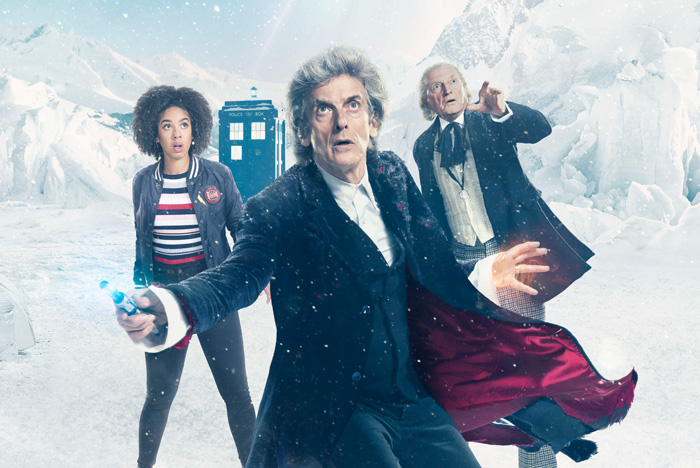
If there’s ever a time for indulging in the past, it’s Christmas, and this year’s special Twice Upon a Time succeeds with that in spades. Perhaps opening with the grandest “Previously on…” in television history, spending a little time in 1960’s Who before William Hartnell morphs into David Bradley (with a nifty explanation for the difference in looks!), and we re-join the end of The Doctor Falls, this time from the First Doctor’s perspective. The traditional multi-Doctor episode bickering begins, until they’re interrupted by a First World War Captain who is just slightly lost.
Twice Upon a Time is a tale of two Doctors and one Captain coming to terms with their imminent deaths. This could’ve been extraordinarily dour to watch, with the characters mulling on their deaths, yet Twice Upon a Time manages the balancing act- dealing us humour, but never at the cost of the gravity of the situation for the characters. Nobody wants to see a constantly upsetting hour of people accepting death, especially at Christmas, so the levity is welcomed.
After Peter Capaldi’s swansong and the arrival of a certain Thirteen, David Bradley’s first in-character performance of the First was the next biggest selling point for Twice Upon a Time. Happily, he’s superb, bringing curiosity and surprising vulnerability in equal amounts to remind us that this is, after all, the very first of our Doctor. There will be some who believe that the First Doctor is misrepresented at points, with a questionable attitude. I understand however why Moffat painted in broader strokes here, as most writers do with past Doctors in multi-Doctor specials- to reflect the First Doctor as a product of the era, rather than the character himself. It also gives us an in-story impetus for The Doctor to regenerate as a woman, given his appalled reactions at his younger self. I saw the First represented here as a bit dated- a product of his era, and no smear on his character or wonderful stories.
Twice Upon a Time and David Bradley give us an impression of the First Doctor that pays more than its fair share of tribute to the character’s true incumbent. The scene of the First admitting his fear of regenerating to himself, thousands of years later, with the strings of Doomsday lurking in the background is heart-rending. As is his admission to Bill of why he left Gallifrey, making it especially moving when Bill tries to explain to him who it is that does keep that balance- it’s a bloke, a silly man (now woman!) in a box. After seeing examples of the Doctor being a god-like hero in recent years, it’s nice to see him talked about like this here- just someone looking for the balance of good in the universe, being kind.
The chemistry between Peter Capaldi and Bradley is a delight, bouncing off each other, their relationship a very granddad and grandson one, with Twelve’s adamant shout of “I am younger!” summing it up. It’s great fun to see Capaldi’s confidence as he declares that the First “gets there in the end” being knocked down as the First grows more exasperated with him, chastising him for the sonic sunglasses and waving the screwdriver around ala John Hurt in The Day of The Doctor and First’s discovery of Twelve’s guitar is hilarious.
Away from the usual banter between incarnations, there’s a strong exploration of the journey that these two Doctors have gone on, from Twelve declaring as protector of Earth early on and the First’s reaction to this, to the First’s powers of observation in the hauntingly crafted Chamber of the Dead. The First is shown his future as the Doctor of War, all his bravado moments and destructiveness to come (to be fair, they cut out all the jokes), as Twelve waxes lyrical boasting of his plan (to the First’s disbelief) to stop Testimony- who, refreshingly, turns out to be benevolent, which allows a lovely lamp-shading of the show as Capaldi expresses his disappointment that there’s no big plan to stop.
This isn’t just the tale of two Doctors though, with Mark Gatiss’ role as the Captain providing a huge source of empathy throughout. It’s a remarkably understated performance, and his moment of admitting to a newly-gained fear of death as his hands shake is powerful. His story mirrors the Doctors, with his opening scene in the bunker one fraught with tension, and the reaction to “World War One” still lands as crushingly as it did in the preview clip. His presence in the story gives the Doctors a reminder of their own mortality and why they must move on and hold on to life. The Captain isn’t the only other character of course, with Bill taking a place too. Twelve’s reaction to her return- instantly dashing out of the TARDIS to hug her- is a lovely thing to see, as is his demanding to keep here in the TARDIS as they arrive on Villengaard to extract information on Testimony from another returnee, Rusty the Dalek (that came out of nowhere!) so he does not fail his duty of care to her again, “real” or not.
Bill’s return works for me completely because it fits so beautifully with the story they tell with Testimony and the rumination on our memories and experiences. As they say in the episode, what are we but a collection of memories anyway? Does it make us any less real if we aren’t the “original”? It applies thematically to the Doctor’s regenerations also, which makes Bill’s fury at him being an arse towards her more poignant. After all, she’s standing right in front of him, tying in nicely with what Twelve said himself in Deep Breath to Clara. Bill’s just as wide-eyed, inquisitive and brimming with personality as she “was”- so why can’t the Doctor accept her as real if she’s had the same exact experiences?
Twice Upon a Time is a story about the nature of memory, clinging on to the wonder of life and being kind, above all else. While it may feature two other Doctors, this is Peter Capaldi’s swansong- it belongs to him. The superlatives in which to describe him have long since burned out from overuse, and his performance here covers all the bases of his fully formed Doctor- the massive, goofy smiles, the rock n’ roll attitude, leading to the simple exhaustion of his life. With that, we’re provided perhaps the most awe-inspiring regeneration of the modern era.
The closing ten minutes of Twice Upon a Time put a perfect, nostalgic, sorrowful yet resolutely hopeful and joyful bow on Moffat and Capaldi’s run. The Captain is the catalyst for both Doctors to change, and the return to the trench provides moment after moment of emotional release, as the Captain reveals his Lethbridge-Stewart heritage and the First promises to check in on his family. It’s this small act of kindness that provides them the courage to go on- the First initially can’t see the Captain’s importance, but Twelve sees it- after all, everyone’s important to someone.
The troops on both sides rising from the trenches to begin the Christmas Truce of 1914 is one of the most purely wonderful scenes in the show’s history, the culmination of the Doctor’s good and Twelve’s arc- he took one man, who his First incarnation could not see the importance of, and gave him a chance to live. He’s not the Doctor of War- he’s a good man. He’s just a Doctor. One simple act of kindness echoed back to his first life and led to the rest of them. Perfect, coming from the man who started his life questioning his very soul. It’s transcendently shot by Rachel Talalay, the sense of space alone in the trench as the Doctors stand amongst it making me well up as the soldiers sang.
As for Murray Gold, if this is his final bow, then how beautiful a score to go out on. The call-backs to his legendary themes alone make this a nostalgic journey, as is the return of Breaking the Wall for the regeneration itself (what else?) but his final version of A Good Man? is shiver inducing, one final triumphant theme for the Doctor upon this life’s final kind act. There’s no need for the question mark anymore. Looking upon each other, the Doctors have immense pride in their past and future.
The final appearances of Bill, Nardole and yes, Clara, were immense. It doesn’t matter in the end that he admits they aren’t technically there, mournful that everyone he loves has fallen on his battlefield, mirroring the scene with Bill in The Doctor Falls. After the episode spends so much time saying how important memories are, it’s vital he got his Clara ones back- he’s earned them. One last gift, and hug, to thank Bill and Nardole for everything they were to him, a release. As Bill says, the hardest part of knowing the Doctor is letting him go. It’s the same for the Doctor.
The regeneration is a predictably tearful one, but it doesn’t betray the themes the story has preached. Twelve’s final speech, delivered (oh, to hell with being out of superlatives) with the thunderous force of a tsunami yet tenderly and lyrically by Capaldi, is like a fairy-tale, bookending Moffat’s run at the same time as he frantically gallops around the TARDIS one last time. For a Doctor who talked and mused alone so much, guitar and all, its only fitting that he addresses himself and then his successor, passing on the messages he’s learned in this life. It’s not a speech of ending, it’s one of continuation. His final few words are the truest to the Twelfth Doctor- laugh hard, as he grew to do, run fast, like a penguin with its arse on fire, and be kind- without hope, without witness, and without reward. Thus, ends my Doctor. But not really.
Jodie’s first scene! Filmed so that we see her the same time as she does, and as the original Doctor’s Theme plays out, there’s an immediate sense of style and tone change, one of optimism for the future. Just look at her enthusiasm! And she’s kept the accent! So then, new era, free of baggage, and ready for wide-eyed adventures and discovery going off the two words we got from her. Except the TARDIS is exploding again and she’s fallen out of it. Autumn 2018? Oh brilliant!
Summary
Twice Upon a Time is an exceptional final bow for Peter Capaldi and Steven Moffat, a Christmas special that has a great pride for the past and an even greater excitement for the future in a proud and heart-felt episode pulsing with emotion throughout. Twice Upon a Time is one of Steven’s greatest stories, with action already resolved in the Series 10 finale, allowing an epilogue for the Doctor to see that more importantly than any of the running or the fighting monsters, there must always be good in the universe- why he simply must carry on. Peter’s final performance encapsulates everything wonderful about his Doctor, one final rock n’ roll extravaganza, wild hair, attack eyebrows and all, before his final moments- proving to himself without doubt, what he is and only ever was- a good man. With one final act of just being kind. Peter, you’ll be missed!


