
Black Mirror: 306 “Hated in the Nation” Review
Reviewed by Ryan Monty.
(This review continues spoilers. Read on if that doesn’t bother you!)
Social media can be many things. It can a source for absolute good, getting the word out about charities or spreading vital news to name just a few powers social media has. But naturally social media can often bring out the very worst in people, from echo chambers of hatred to online witch hunts. And here is where we find ourselves in the final episode of Black Mirror series 3, Hated in the Nation, a good ol’ feature length Black Mirror instalment to see us off into the cold darkness until series 4 rolls around.
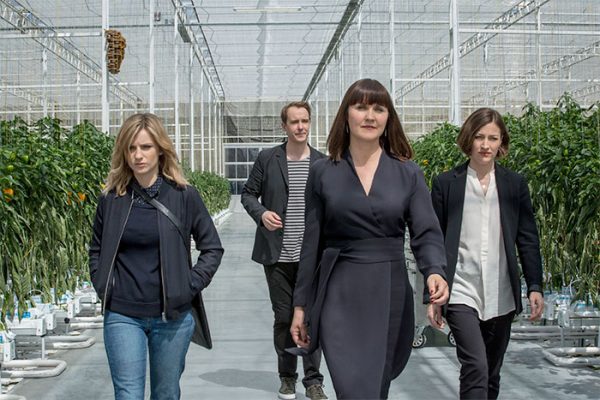
Our two protagonists this episode are weary, grizzled veteran of the Met Police Karin (Kelly Macdonald) and Blue (Fay Marsay) who is assigned to her as a shadow. She’s a tech whizz-kid who left forensics to work “out in the field” after witnessing the horrors of the Rannoch case (a straight connection to series two’s White Bear). Karin has the best kind of seen-this-all-before attitude about her – she’s a divorcee who has seen just about everything in her line of work – in one early scene she buys bags worth of food to cook, instead resorting to a junk food drawer and planting herself on the sofa to watch TV, world-weathered as she is. Blue however has the wide-eyed twinkle in her eye, and wants to do legitimate good in her job. She doesn’t need talking to, and is a nice flip of genre conventions – she is head-strong and consistently useful in most situations, not needing her hand held.
Macdonald and Marsay have a fizzing chemistry between them, the perfect mismatched pairing, feeling like an off-shoot of the classic “believer and non-believer” trope, with Macdonald’s Karin feeling decidedly sceptic about many of the goings on and infusing ordinary logic into some of the more outlandish statements from Marsay’s heavily technology savvy Blue. They’re a joy to watch together and carry the story an extra level higher. I could very happily watch an entire series dedicated to them (although Brooker has said they may come back at some point).
The two are called in to investigate the possible murderer of a news writer, who absolutely, definitely, isn’t meant to be an analogue for Katie Hopkins, found dead in her home with no apparent signs of a break-in. From there we enter a tale of surveillance, online bullying and hate mobs, told through the lens of our new technology of the episode, robotic bees called ADIs, designed by a private tech firm (with helpings of UK government funding) to replace the natural honeybee population which has become extinct, one of whom killed the writer. In true procedural drama fashion, there are more than enough stings in the tale (sorry not sorry) from this point onward.
One of the true joys of the latest series of Black Mirror has been its willingness to play and experiment in other genres, yet still be consistent with the major themes of the show. The versatility and variability of this series has given it great power, with last episode being a war film, San Junipero being a romance story and so on – and with Hated in the Nation we have a story firmly with its root in the procedural drama. Charlie Brooker himself as admitted as much, saying he hoped to create his own attempt at Scandinavian dramas like Borgen and The Fall. Brooker’s script and director James Hawes (veteran of television direction with shows like Doctor Who, Penny Dreadful and DCI Banks under his belt) have crafted a story that unravels at a slow, methodical pace, unlocking the secrets of the best content in the genre while still having a great sense of urgency.
The feature length seems entirely warranted – there’s so much at play inside Hated in the Nation that anything less than a full fat hour and a half would seem like a cheat. Moral complexity oozes out of every aspect of the episode, and the length allows it all to be fully explored. The wonderfully other-worldly score by Martin Phipps adds immeasurably to the feeling of the piece, owing more than just a few tips of the hat to Mica Levi’s standard-setting Under the Skin soundtrack, while the ending song, specially written for the episode by singer/songwriter Alev Lenz, gives the final denouement the extra gut-punch feeling of hopelessness that it needed to be effective.
The true moral at the core here is that words have immense power – enough to take a life – and they aren’t simply “half-hate” as Macdonald’s Karin exclaims. Using the bees as an analogy for online behaviour is simply inspired, given when the internet’s frightening tendency to form online witch-hunts reaches its peaks it can do actual awful damage. Actualising that into a physical swam of killer bees is the exact kind of concept needed to bring it all to life. It’s a scarily prescient realisation of our online conduction and the exact repercussions that people’s behaviour on the web just doesn’t have. The regular rituals of wishing individuals online – often total strangers – death isn’t a new concept, it already happens every day. There will be always be someone doing it, not stopping to think of the cruelty or lack of empathy in their actions and just residing in the joy of taking their frustration out on these people.
The focus on blame and responsibility cuts through the story, with most characters involved happy to shift the culpability to someone else. It’s no coincidence that the primary school teacher who starts it all is a seemingly completely normal individual, but under the online mask she’s wished death upon someone and instigated buying a “hate-cake” for that person, and is happy to hide behind the mob she generated for the cake, and shift blame onto the other eighty people who bought into the cake. It’s under this veil of faux-responsibility and lack of consequences under which Hated in the Nation’s ultimate scythe falls.
The bees of the episode are very much at the side of the story for a lot of the run time, barring some terrific sequences, including the stand-out scene at a safe-house that veers into Alfred Hitchcock’s “The Bees” territory with swarms of tiny robotic abominations attacking. It gets your heart racing at a hundred miles an hour and the breathlessness goes on agonizingly long under the assault of the technological terrors. Within this is one of Hated in the Nation’s greatest successes – taking something potentially very cheesy into something frighteningly effective- while the bees are out there in the environment under the guise of being an environmental replacement after a major extinction, they’re also being used as a government surveillance system to spy on us. Just think about it- millions of tiny robots, which could be anywhere, listening to and watching you at every step. The noise they generate sticks rhythmically in your head like a droning nightmare, a persistent buzz like the online swarm felt by all those at the centre of the #DeathTo hashtag. It may not be the subtlest metaphor, but it needs to be this obvious to make the point at its most cutting. All it takes is the will of the people to send a literal swarm of death towards a chosen person, and actualising that message as so makes the morals at play here even more like a slap in the face to everyone who ever sent a mean Tweet or worse over social media.
Hated in the Nation may have the most important messages that this series has telegrammed so far- in our culture of total internet shaming and free-spirited attacks on anyone and everyone behind the mask of the web. By the time the crushing inevitability of the ending arrives and the death that comes with it- death that isn’t seen on screen at all, instead going for a quiet final coda proving that the outcome is just as horrific whether you see the result or not- the finger is pointed squarely at every single one of us.
So, with that, Black Mirror is over until next series. And while for most shows that’s a bad thing, maybe after six episodes of varying emotional trauma, a nice little break, cup of tea and something a shade lighter may be what’s in order. That is until the next instalments of bleak fables from Charlie Brooker come along like a knife to the soul to make us question everything we believe in and turn us all into existential quivering wrecks. Until the next time then, Charlie. Make mine extra dark.
Verdict: 9/10


