
Black Mirror: 403 “Crocodile” Review
Reviewed by Ryan Monty.
(This review continues spoilers. Read on if that doesn’t bother you!)
Charlie Brooker has long preached that Black Mirror never positions technology as the villain; rather it’s simply the tool in which the worst of us is brought out. So far in Season 4 we’ve had Robert Daly abusing an advanced virtual reality game which allowed him to enact his power fantasy out on copies of his co-workers in USS Callister, and a helicopter parenting aid allowing the direst parental impulses and worries to be revealed in Arkangel. The third episode of Season 4, Crocodile, sees technology simply light the flame to something sinister implied to be trapped deep within us all- just how far would we go to ensure our survival and freedom, and at what cost? This is Black Mirror’s take on Nordic-noir, and true to form, it’s a bleak one.
Crocodile has the most impactful opening of Season 4 thus far, with couple Mia (Andrea Riseborough, who’s popped up everywhere in recent years from Birdman to The Death of Stalin) and Rob (Being Human’s Andrew Gower) driving home from a rave, still abuzz from the night before Rob unexpectedly slams into a cyclist, instantly killing him. In the panic afterwards, Rob decides they must dump the unfortunate hit and run victim in the fjord nearby, which Mia agrees to after some tough convincing. It’s the kind of event that stays with you and will almost certainly come back to haunt you, no matter how much you’ve moved on or succeeded fifteen years later, when we pick up with Mia after the title card. It’s no coincidence that the song at the rave is Strict Machine by Goldfrapp, as Mia is about to lose all control all over her life, that she will make even worse.
Crocodile was filmed on-location in Iceland (although the accents are baffling, with various English and Scottish brogues popping up all over the place- where in the UK looks like this?!) and suffice to say, it was worth it. Director John Hillcoat of The Road and The Proposition and his cinematographer Lol Crawley (Utopia) bring a balance of unrelenting grimness and beauty to the stunning backdrops, with the uncaring nature of the icy locale matching perfectly with the gradually cold morality and actions of Mia. The score for the episode by the composing team of Atticus Ross, brother Leopold and Claudia Sarne is a droning presence, cranking up the intensity unbearably throughout.
It doesn’t take long for the past to come back to haunt Mia, who now has a settled family life with a husband and son, a beautiful house and a highly successful career as an architect, and the return of Rob right on the doorstep of the hotel room she’s staying at for a conference is almost definitely the last thing she could’ve ever wanted at this point of her life. Mia appears calm and well-adjusted in the scenes set in the present prior to this, so to see her fling expletives at Rob as she does is a signifier to how deeply the past cuts her still.
The duo of Mia and Rob are intrinsically linked by that one awful moment, and Rob represents the disconnect between her old life and her new. She’s blooming, while Rob is out of shape, wounded by the event and keen to finally make amends as part of his alcoholic recovery plan. It’s a sudden shock for Mia, and triggers something within her, a need to preserve the life she’s created. As Crocodile progresses, Mia becomes Rob from the beginning, their roles reversing- Rob, regretful, a need to confess, and Mia, willing to do anything to banish the unwelcome reminder of the sins of the past.
The character of Mia is maybe the most gripping of the season so far, another fantastically written female lead. Unlike Nanette or Marie though, Mia is resolutely more difficult to sympathise with as the episode progresses, given the monster she becomes, despite the initial sympathy after the accident which, after all, dragged her into a mess she had no desire to be part of. It makes it even more intriguing that the character of Mia was originally written as a man, as admitted by Brooker at a screening, though it’s difficult to image anyone else in the role regardless of gender, Mia being chillingly brought to life by Riseborough, her eyes as passive at times as the animal of the episode title.
There is of course a new technology to bring out the worst in the character of Mia, and it’s a deliciously simple one- by the name of the “Corroborator”, the tech looks wonderfully future-retro, essentially a big lump of plastic looking right out of Blade Runner. It’s not something immensely far off either, given scientists from the University of Oregon in 2016 created a crude version of this tech to help visualise faces from memory- like Arkangel, this is something we could very well see in the near-enough future, and it’s unsurprising that we follow the device of the episode being used by someone working for an insurance firm, an inevitability once the tech would be available for wider use. It’s a bit of tech reminiscent of older Black Mirror episodes once again, most notably in the themes of memory and privacy from The Entire History of You.
Attach a little device to your head, and it lets the user see the memories of the person attached to it. It’s not a reliable machine though, and to build a full picture many accounts are gained to avoid inaccuracies with sensory triggers used for recollection- Crocodile’s scenario, in an attempt to gather information on a person’s accidental collision with a self-driving pizza van (why can’t this be a thing, right now?) uses a bottle of beer and the song that Black Mirror loves so very much, Anyone Who Knows What Love Is by Irma Thomas (and its use becomes a poignant one), which were both triggers present at the incident that the true protagonist of the story, insurance claim validator Shazia (Murdered by My Father’s Kiran Sonia Sawar) is investigating- whose plot runs parallel to Mia’s own.
In an episode as unremittingly bleak as Crocodile, Shazia brings a refreshing happy go-lucky personality to proceedings, a sense of Fargo’s Marge about her, as she gets on with business to the best of her abilities. She’s maybe one of the most likeable characters the show’s introduced, which makes her demise a moving and saddening one, and completes Mia’s transformation into unfeeling monster- the moment she stands above Shazia, log in hand, debating whether to kill her, is a distressing watch, as Shazia begins to desperately prayer right in front of her. It’s a heavily impactful punch to the gut.
It’s about this moment that I can see the disconnect some will feel from Crocodile, and as she goes on to murder Shazia’s husband and baby- however, it presses home the point that the technology didn’t really force Mia into any of this sheer cruelty, and it was necessary- in her eyes. Naturally, keeping your most private moments hidden is an overriding impulse of us all, but to go to such extremes to do so? The Corroborator only enabled Mia to indulge darker tendencies she was clearly capable of, from adeptly creating an alibi for herself at the hotel after Rob’s death and dragging his body to melt in a construction site to checking Shazia’s memories for who else could link her to the murders. For being dragged innocently into a horrific situation many years ago, Mia does everything in her power to make it all so much worse, pulling innocent people into her orbit.
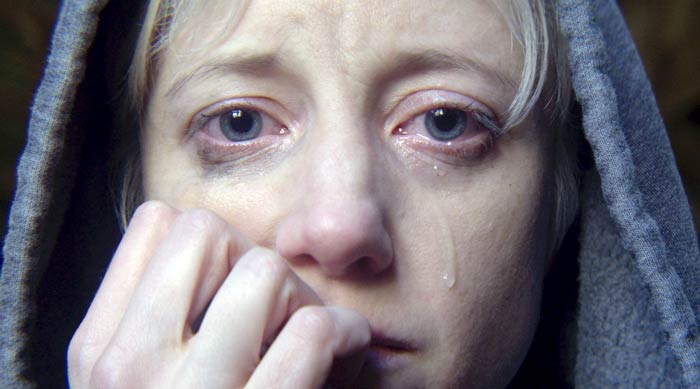
To all our relief, Mia is eventually caught, and for all her troubles, her hubris and monstrosity is exposed, thanks to- of all things- a guinea pig. It’s dark comedy at its darkest, especially given the baby had no need to die given its blindness. Though we don’t see her get physically caught, Mia is done for, and we get one final pitiable look at the woman beneath the creature capable of her actions- as the successful Mia, the loving wife with a son, snuggling into her husband’s arm as they watch their son’s school performance of Bugsy Malone, the song namely being the pitch-perfect You Give a Little Love, Mia crying presumably more from pure exhaustion than any real remorse. Therein lies the title- Crocodile tears at their purest.
Summary
While the connective tissues between Shazia and Mia’s stories take time to attach, which admittedly found me drifting, the longer I reflect on Crocodile the more I like it- although “like” may be the wrong word. This is undoubtedly an oppressively sad yet darkly comic hour of Black Mirror. What Crocodile does brilliantly is present to us a character study of two women (one brought colourfully to life by Kiran Sonia Sawar, one brought as icy as the setting by Andrea Riseborough) both with loving families, and delves into the abyss of how technology allows them to be forces for good, or pure evil, dragged together through circumstance only to be both torn apart. Maybe there’s some unspeakable, horrible place in our hearts after all, that maybe in a similar situation, some of us could be able to act in the same fashion as Mia. After all, Anyone Who Knows What Love Is, will understand.


