
Arrow: 519 “Dangerous Liasons” Review
Reviewed by Louis Rabinowitz.
Superhero stories and morality have an uneasy relationship by necessity. We accept that superheroes, for the most part, are the good guys whose efforts we root for and we’re conditioned to mistrust the authority figures who are hell-bent on stopping them, but that creates something of a twisted moral compass. Vigilantism is illegal, often immoral, and unaccountable which means that any action can be taken, however extreme, if it’s deemed necessary with no consequence, and most superhero stories tacitly accept this and move on. Arrow, however, has always been fascinated with its own wonky take on morality with Oliver Queen, the poster boy for questionable heroism at its centre.
You’d assume, therefore, that an episode that explores the question of what methods can be justified to achieve an objective of protecting society like Dangerous Liasons would be right in Arrow’s ballpark. Some of the best episodes this season have been little morality plays that have tested just how far Oliver has been willing to go to save his city, and so an episode that shines that spotlight of scrutiny onto Felicity seemed like a promising one. It’s surprising, therefore, that Arrow doesn’t strike the requisite balance here. It tells a compelling and enlightening character story wrapped in a moral dilemma that’s messy and uncertain between options that are somewhat difficult to pick apart. Dangerous Liasons is still a good hour of television, but where it goes wrong, it becomes one of the most notable missed opportunities in a year where Arrow has come close to achieving its lofty storytelling ambitions.
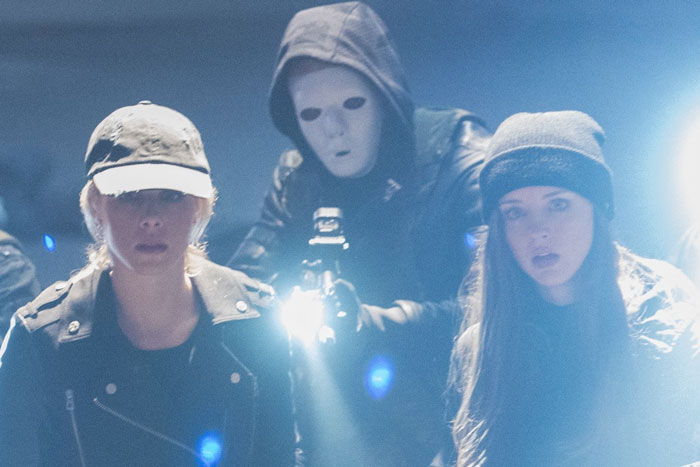
The crux of the episode was Felicity’s slow-burning movement over to the hacker group, Helix, which came to a boil over the question of capturing Adrian Chase. Felicity, it’s safe to say, hasn’t been the best-liked character on the show for some time, but her individual arc this year has been genuinely good and refreshingly intent on defining her independently outside of the romantic subplots that have so often inhibited her. Felicity’s choices to keep going deeper with Helix despite the moral compromises needed to do so generally made sense because they were simple – a principle or two sacrificed in exchange for valuable information. On a purely character-based level, that success continues here. Felicity’s motivation, when it’s revealed, is the kind of illuminating character insight that Arrow has become much more prolific at offering this season – rather than harbouring distaste for Oliver’s flexible morality, she is instead driven to emulate it out of a desire to lift some of his burden and accomplish some of his quest for her own ends.
That’s a solid motivation that introduces a good amount of ambiguity to the way in which the audience is meant to perceive her. Felicity’s goals are wholly benevolent in the long run, but in the short term they illustrate the destructive long-term consequences of Oliver’s influence on her. It’s not wrong that Felicity is driven by a quick fix to the Chase problem this episode, because we’ve seen her being taught by those around her that the quick fix often does the job, regardless of the moral costs. It provides an interesting new dimension to her relationship with Oliver where he’s cast as an accidental mentor of the worst kind to Felicity, and Oliver’s antipathy towards her behaviour rings true because it represents the moral flexibility he’s been trying to escape from for quite some time. As an exploration of what makes Felicity tick now that she has to redefine herself on her own, while still beset by the trauma of grief, Dangerous Liasons works.
It’s when Arrow starts to talk about morality where the cracks start showing. To its credit, Dangerous Liasons aims high. The stand-off between Helix, ARGUS and Team Arrow over ideology and a practical objective of rescuing a hacker is a pretty intricate plot for one episode to tackle, especially when each group is meant to represent a different take on morality from which the episode can draw its eventual conclusion. As a result, Arrow’s attempts to draw moral contrasts here become convoluted pretty quickly. Helix, as a group at least makes sense – they’re borderline extremist hackers willing to do anything in the name of ‘freedom’, even if their behaviour (especially Felicity’s perky hacker ally) is flippantly dismissive of the idea of consequences for their actions to a somewhat unbelievable degree. ARGUS, partly because we haven’t spent much time with them lately, are harder to tackle. To its credit, Arrow tries to make their fight with Helix a morally grey one – Helix is violent while ARGUS is authoritarian, but it also tries to position ARGUS as allies to Team Arrow that we’re never meant to reject, which suggests we’re meant to feel more sympathy for them by default.
And then there’s Team Arrow, caught in the middle and trying to do the right thing. The problem is that we never really know what they stand for, as the team, and Oliver’s, morality is defined by being in opposition to both the violence and the authoritarianism despite linking up with ARGUS an opposing Helix. The best I could tell is that the solution Team Arrow wanted to the Chase problem was… the best solution, which is a curiously simplistic argument for an episode that tries to portray a situation for which there are no good answers. And as Felicity points out, it rarely works when Oliver is placed as the beacon of stable morality who is free and willing to judge others. As a result, it’s sometimes difficult to tell what kind of story this is, and why Arrow is telling it. It’s all very well and good to paint a clash of anti-heroes with good intentions, but there has to be a point to it at the end, even if it’s as simple as saying that the ends shouldn’t always justify the means. Dangerous Liasons comes close to saying something, but never really gets there – Helix’s efforts, after all, work out in Oliver’s favour as he’s able to obtain a device that tells him Chase’s location. It’s an example of how tough it is to tell a morality story that walks the line between opaqueness and patronisingly talking down to the audience, and how skilled Arrow has been in the past at striking that balance in a way Dangerous Liasons doesn’t manage to.
In amidst the morality shenanigans with Helix, Dangerous Liasons returned to a plotline it hasn’t explored for quite some time in Diggle and Lyla’s marriage. Often, Arrow does a little better with its slightly more experienced characters who tend to have more mature conflicts, but that wasn’t wholly the case here. There was enough to appreciate in this conflict, such as the affecting conclusion where Diggle and Lyla realise they’re repeating the past’s mistakes in a way they seem powerless to stop, and David Ramsey and Audrey Marie Anderson are convincing throughout, yet it never gets past the fundamental awkwardness of it all. Big conflicts of this kind can work – Oliver and Felicity’s feud this episode was a chief example of this – but there needs to be some kind of build-up to the explosion. Diggle and Lyla’s conflict wasn’t noteworthy before this episode, which makes the sudden introduction and escalation of tensions feel curiously abrupt and unsupported by recent events. It’s hard to get invested in a story that feels like it exists in a vacuum from everything else despite the way in which it deals with the same themes of moral compromise as elsewhere, no matter how hard the actors try, and as such the plotline never really gets off the ground.
A character story that did work very well, in contrast to Diggle and Lyla, was Rene and Lance’s. Admittedly, it has nothing to do with the rest of the episode, and realistically it could have been inserted into any other instalment with little trouble, but it has enough basis in the flashbacks to Rene’s backstory a few episodes ago that it works just fine from a standing start. It also helps that the storytelling here is brisk but still sensitive, covering a lot of material while always exploring the emotion at its heart. Rene and Lance make for a very good pairing that naturally fit together – the grizzled ex-cop with the young hothead who mistrusts authority is a familiar set-up, but there’s enough nuance to their pairing, such as the way in which Lance seems to exorcise some of his grief over Laurel vicariously through Rene, or with Rene’s visible respect for his mentor, that it works anyway. The father-daughter reunion that the plotline builds to is brief but poignant, suggesting a complex web of emotions in a way that’s impressively concise without resorting to obvious, didactic exposition. It’s a story that does a world of good to Rene, who’s become a drastically more layered and interesting character in recent weeks after his fairly one-note early characterisation, with his hotheadness established as a character flaw that he’s keenly aware of and wants desperately to fix. Sometimes Arrow does some of its best storytelling in the sidelines, and this effective if peripheral subplot was a great example of that.
Sometimes, a rough episode needs a good cliffhanger, and Dangerous Liasons delivered with an ending that sets up next week’s bottle episode in a far more interesting way than I expected. Okay, no-one expects that explosion to be real, and the promo revealed as such, but the twist that Chase is either in the lair or has set up a tracker there is an effective one that’s given so little time to unwind that it can’t help but feel shocking, even if it’s a very typical switcheroo. Oliver and Felicity’s conflict is pointedly left unresolved at the end of the episode where it’s abundantly clear the characters would like to leave the room as soon as possible, which makes their imminent situation of being trapped together a really interesting proposition. The bottle episode is a difficult proposition, one that can result in a rewarding and incisive slice of character drama or a claustrophobic slog, but Arrow’s improvements in character interplay recently are promising signs. If there was any time to do a bottle episode before the end-game of the season kicks into overdrive, now’s the time.
It’s tempting to be overly harsh towards Dangerous Liasons, an episode that doesn’t manage to achieve the objective that it’s very clearly aiming for, so it’s worth qualifying that this was a strong instalment for character development, whether that’s with Felicity, Rene, or to a limited extent, Diggle and Lyla. It’s just that its attempts at complex morality are atypically clumsy as the episode fails to really define the choices the characters are making in relation to each other, which makes the episode come to a far more prosaic conclusion than the intricate build-up suggested. It’s by no means a radical disappointment, but it’s a slight step down after the impressive heights of recent episodes.
Rating: 7/10


