
Legends of Tomorrow: 112 “Last Refuge” Review
Reviewed by Louis Rabinowitz.
If there’s one word to describe the progress of Legends of Tomorrow over the season thus far, ‘chaotic’ would probably cover it. The show has stubbornly refused to fit into the traditional categories of a freshman season, neither shooting out of the blocks fully formed nor starting rough and gradually working its way up to redemption; take the fact that mid-season, when you’d expect the quality to have levelled out a bit, its best episode was immediately followed by its worst. The inconsistency is somewhat endearing in a way, lending a rare week-to-week unpredictability that’s not always present in factory-line network TV shows, but is Legends showing any signs of truly finding an even keel from which it can launch into the season’s endgame?
From the looks of this week’s episode, absolutely not. Last Refuge is textbook Legends; hugely entertaining sci-fi that clips along at a rattling pace that’s let down by fundamentally shaky foundations and a tendency to rush past moments it really ought to slow down for. The stories and character arcs here could have filled a full multi-episode arc, which perhaps explains here why the storytelling feels compressed to an inch of its life; tightly-packed to the point where some character beats and plot points struggle to breathe. And yet, in amidst the flurry of cack-handed time travel logic and character arcs that play out a few inches off-screen, there are signs of real, genuine progress that the show has made. It’s a similar episode to Star City 2046 in that it’s both incredibly fun and complete nonsense – but, unlike that earlier effort, Last Refuge is frequently thoughtful and turns in a handful of excellent character moments that utilise the premise really effectively, enough so that the lack of internal logic doesn’t feel like the crippling flaw it did in earlier episodes. If it felt like the show was relying on DC comics fan-service to cover up its flaws in earlier instalments, especially Star City 2046, then it has to be a sign of progress that Last Refuge stands on its own two feet, relying purely on what makes Legends and its characters work and only using the larger universe to supplement the narrative instead of using it as a crutch to cover up the show’s deficiencies.
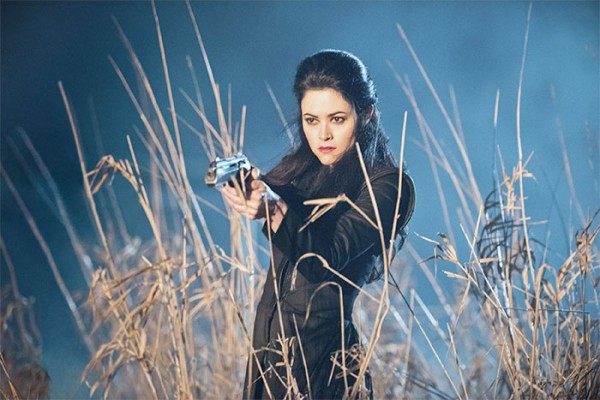
The central premise here was another classic time travel idea of the team’s past selves being hunted down by a ruthless assassin in order to erase them from the timeline. Last Refuge, on the whole, makes a better go of this concept than Progeny did with the equally timeless ‘would you kill Hitler?’ quandary two weeks back, and it uses it for two very different ends in the first and final acts. The first act is perhaps the episode’s high point – a taut fifteen minutes of television that launches headlong into the threat of the Pilgrim while barely pausing for breath. It’s exciting, snappy, and manages to communicate the ruthless resilience of the Pilgrim as she just keeps on coming, learning from her mistakes and posing greater and greater challenges to the Legends, all despite the fact that there’s very little tension that the Pilgrim will really kill off any of these characters. Last Refuge shows some warning signs by laying out some very arbitrary guidelines from the get-go, but in the midst of the madcap spring that makes up the opening chapter of the episode, this reviewer was far too entertained to care about the logic behind it all.
Though the first and final acts are broadly great (we’ll get to the final act… at the end of this review), Last Refuge can’t keep up the dogged momentum for the full 45 minutes – as fast-paced as this episode is, as it goes on the cracks begin to show themselves. The problem here isn’t necessarily that the time travel presented in Last Refuge isn’t that logical – as this show has displayed, that doesn’t need to be a drag on quality is the episode is sufficiently compelling elsewhere and there’s some time travel rules present. It’s less the Pilgrim, and her strangely inefficient and ineffective methods, that drags down Last Refuge, and more the way the younger selves are handled throughout the episode, which quite frankly makes no sense at all. No one ever seems fazed by the fact that the past characters are being shown things that would completely destroy the timeline if they remembered, and even the vague through-line brought in that older selves shouldn’t interact with their past selves is forgotten about towards the end.
Time travel stories usually have characters take care not to reveal much to younger selves in order to keep the timeline intact, an idea that both preserves the logic of the episode to some end and provides a good amount of tension regarding whether the past self will find out what’s being hidden from them, but Last Refuge only pays brief lip service to this idea before losing interest well before the episode is done. This would make some sense if the episode was building up to a crucial retroactive change in the characters; a repercussion for their clumsy and excessive meddling, but Last Refuge hand-waves that idea away with a convenient amnesia pill that saps out the potential for intriguing consequence-led drama in favour of an easy reset. The same very much applies for the loved ones kidnapped by the Pilgrim to draw the Legends out. Last Refuge manages to effectively up the stakes going into the final act by putting so many characters important to the Legends in danger, but Last Refuge only wants, for the most part, to use them as a threat, ignoring the vast potential for character development that’s right in front of it. It’s understandable that the episode didn’t want to give everyone a substantial character arc, but it’s moments like the implied kidnapping of Snart’s sister (I know Peyton List is busy, but this felt kind of cursory) or the lack of reunion with Ray and his ex-fiancée despite its direct applicability to his arc this episode that shows off this episode’s proclivity for only using half of its ideas and leaving the other half as mere potential.
Legends has done a good job of showing a clear cause-and-effect from the characters’ bull in a china shop routine in the timeline before, so it’s strange here that the time travelling and revelations to the past selves yields very few consequences. The reset button isn’t pressed entirely, as it’s notable that Last Refuge does use the kidnapping of the past selves as a surprising way to inject some urgency into the Vandal Savage plot by forcing the Legends to attack him at the height of his powers. At the very least, that’s some commitment to serialised storytelling, but it’s ultimately just a slightly different way than normal to pivot into the premise for next week’s instalment; the net result is the same as normal, in that the team plot to attack Vandal Savage in a time period that’s more dangerous than the last. Mostly, though, this just feels like Last Refuge didn’t want to fully commit to its premise, taking all the fun bits without the credible logic and cause-and-effect that justifies all of the fun. It’s an enjoyable take on the idea, but one that doesn’t fully take advantage of all of the potential because of the missed opportunities for character development that are rife here.
However, the substantial character arcs we do get are genuinely great. It’s with Jax’s story that Last Refuge derives most of its emotional impact with an efficient and emotional arc for Jax that greatly advances our understanding of the character while playing with time travel as a concept in a far more interesting way than most of the episode. Franz Drameh has really settled into a groove as Jax as the season has gone on, and he proves capable of handling the emotional heavy lifting here with a performance that’s, if not heart-breaking, then certainly affecting enough to sell Jax’s pain at not being able to tell his dad. The back-story also does a great deal to heighten the pathos felt for Jax’s character, casting him as a product of tragedies caused by events entirely out of his grasp that completely upend his life (his father’s death at war, the particle accelerator breaking his leg) and thereby deepening our understanding of exactly why Jax would commit to this potentially futile and hugely difficult quest to become a legend. It’s also intriguing that Last Refuge ends Jax’s story on such an ambiguous note – you’d expect to either have the stock tragic ending of Jax’s dad having died anyway despite his son’s advice or the miraculous return of his father, but Last Refuge opts for something far more uncertain that strangely feels endearingly optimistic and hopeful; communicating the idea that, Jax has at the very least made an active choice for the hopeful betterment of his life and that whatever happens next is meant to happen. It’s a nice place to end on, and one that’s actually a lot less predictable than expected, ensuring that there’s not a sense of this plotline plodding dutifully on an obvious trajectory to a pre-determined ending.
Then there’s Mick’s story, which equally adopts an intriguing uncertainty by the end. What’s interesting about Mick’s quest is that there’s not a conventional sense of narrative progression in his interactions with his younger self. Sure, he starts off frostily ignoring his younger self and eventually has a full conversation with him out of pure concern, but there’s never any guarantee here that Mick’s words have had any effect; in fact, there’s an underlying sense that perhaps his efforts are all in vain and that Mick’s journey is simply pre-determined. It’s an example of how Legends is making bolder and less conventional narrative choices as it’s gone on – as Last Refuge shows, its character arcs don’t need to be conventionally rewarding and cathartic to succeed. In fact, Mick’s arc works because it’s innately tragic; Mick is only giving advice to his younger self as an acknowledgement that he wish he had never headed down this path in life and out of a deeply futile hope that he, somehow, might be able to get a fresh start after a pretty terrible life. It’s a dark, morose little character arc that doesn’t take up a huge amount of time, yet it’s one of the most compelling parts of the episode because it uses the concept of the younger selves to explore the fears and regrets of the older characters, enhancing sympathy felt for them because it’s an opportunity to expand our understanding of the vulnerabilities of even the toughest and most stoic characters.
Last Refuge is an odd episode, even by Legends’ standards. Its take on the time travel premise of meeting younger selves is very entertaining, from the madcap hunt of the first act to the gloriously silly freeze-frame final fight that plays out like a live-action splash page of a comic book, but it’s one that occasionally feels hollow with a lot of its potential for character development left entirely untapped. Where it does try and take advantage of the opportunities for development, Last Refuge comes up trumps with some of the best character material to date, delivered with a thoughtfulness and sensitivity that belies the haphazard way in which the time travel mechanics of the younger selves are presented. On the whole, it’s safe to say that this was a good episode; the flaws are troublesome, but they’re outweighed more or less by the occasionally excellent character development and the agreeably fast pace. Heading into the final four episodes of a season, Legends may not be close to truly stabilising, but, in its own unusual and stop-start manner, there’s a feeling here that the show really has progressed somewhat since its early days – let’s just hope that progression continues as we enter the season’s final stretch…
Rating: 7/10
Last Refuge is a chaotic and messy instalment that flubs the chance to explore the effects of meeting their younger selves and loved ones on the characters, but ultimately excels with Jax’s and Mick’s compelling stories and a narrative that’s entertainingly breakneck enough to ride out most of the logical flaws regarding the inconsistent time travel.


