
Fargo: 208 “Loplop” Review
Reviewed by Louis Rabinowitz.
What does it mean to be a woman in the 1970s? It’s the question Peggy Blomquist has been struggling with all season on Fargo, and the method she’s picked to solve it has been actualising, and becoming the best version of herself that she can be. It’s never been clear exactly how Peggy would actualise, what actualising actually is and how that would help her, but those issues have been insignificant for Peggy. If you’re wondering what I’m on about, then it’s worth noting that this week’s episode saw a pivotal moment: Peggy finally actualised!
And if Loplop was any indication, actualising is really not all it’s cracked up to be. After last week’s sweeping emotional epic, this episode went for a more intimate tale, weaving an intricately absurdist tale about Peggy, Ed, Hanzee and Dodd. One of the things Fargo’s shined at this year is taking one ingredient from the heady mix that makes up a regular episode of the show and magnifying it to act as the crux of an episode – Rhinoceros, two episodes ago, saw Fargo’s aptitude for tension-building and action to come to the fore. Here, it was comedy.
Fargo’s always had a wicked streak of quirky humour to it, but Loplop was undoubtedly one of the most outright funny instalments the show has ever produced. Surprisingly, it wrings a lot of that humour from Dodd’s hostage situation – something you’d expect to be infused with darkness and foreboding. Jeffrey Donovan earned his comedic stripes here with style, getting some of the episode’s best gags out of simple facial expressions and body language, wrapping up with a hilariously crackpot-ish speech about Satan being a woman to an asphyxiating Ed. Dodd always felt like a bit of a caricature, but his heightened personality and irrational behaviour felt utterly in tune with this episode’s particularly kooky, absurd atmosphere.
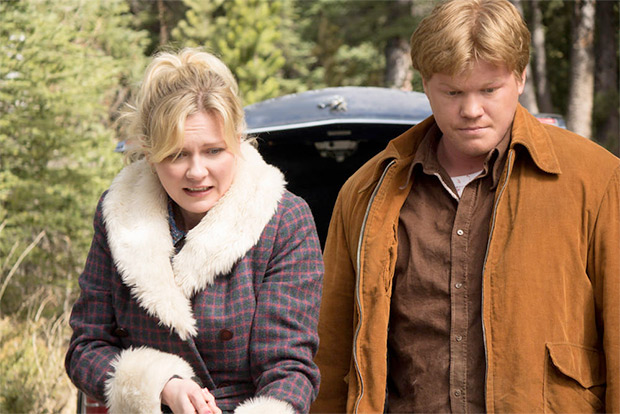
Similar to The Myth of Sisyphus a while back, Loplop is unashamedly absurdist, and it’s with Peggy where a lot of that really shines through. After her actualisation, Peggy was in full-on crazy mode this week, lecturing Ed about taking action and bemoaning her past flaws, promising that she would be a new woman here. It’s darkly humorous, then, that Peggy becomes even more deranged and violent in her quest to ‘become the best me I can be’, hallucinating a life coach in place of Dodd, and poking holes in Dodd with a rather large knife to ‘teach him manners’. As for her desire to take action and ‘just go’ – well, it’s notable that Peggy barely does anything of note this week. That’s the absurdist streak at the heart of Loplop – despite Peggy’s grand proclamations, she leaves every important task to Ed this week and doesn’t even leave the cabin once they enter it. Ed’s not immune either – it takes him three quarters of the episode to successfully accomplish anything in his quest to ship Dodd off somewhere (his bumbling, thoroughly unconvincing attempts to tell the Gerhardts are a comedic highlight), and by the end of the episode even that work is completely undone, with Ed’s net result for the episode resting at zero things accomplished. Fargo has frequently flirted with this type of material this season with the multiple Sisyphus references, but Loplop saw it thoroughly commit to an absurdist tale with excellent and very humorous results.
Speaking of Peggy – it’s worth highlighting Kirsten Dunst, who I’ve been guilty of passing over frequently in these reviews. She’s been a terrific performer all season, but Loplop saw her graduate to Lester Nygaard status with a central performance that’s disconcertingly chirpy and upbeat with a subtly dark undercurrent that hints at some deep-seated issues. Peggy may hide her violence behind a perennially cheerful mask, but Dunst manages to bring out that inner darkness while nailing all the comedy Loplop wrings out of Peggy’s bizarre behaviour. Dunst was one of the more high-profile hires this season, and Loplop sees her deliver her strongest and most varied performance yet.
Aside from all that crazy, slightly unhinged fun at Casa Blomquist, Loplop delivers a compelling side story for an increasingly fascinating character, Hanzee. What really distinguishes Hanzee from your average Fargo henchman is that his motivations are entirely opaque – Hanzee’s not the type of guy to spell out his reasons for doing what he does, so his thought processes always have to be inferred from his scenes. This arguably makes him one of the greatest threats on the show – with no real indication of exactly what drives him, Hanzee becomes one of the most unpredictable characters around because there’s no guarantee as to what he’ll do in any given situation.
Loplop does explore some of the catalysts for Hanzee’s motivations, adding a touch of intriguing sympathy by exploring his plight as a Native American in a prejudiced society in subtle and relatively non-didactic detail and underlining his burning urge to escape from the racial stereotype he’s been cast as. It’s a nice couple of scenes that helps to flesh out Hanzee while preserving his status as a semi-villain and ensuring that there’s still a notable level of uncertainty to his actions. Zahn McClarnon is great all episode, with a kind of self-assured energy that contrasts notably with the image that society projects onto him, and a considerable screen presence that compensates for and augments Hanzee’s taciturn nature.
Everything intertwines neatly in a final act that deftly switches from absurd comedy to nail-biting tension without missing a beat. It’s a final sequence that’s layered with palpable tension and intriguing ambiguity – in Hanzee’s case, it’s his actions when he reaches the cabin that are open for a huge amount of interpretation. Just what, exactly, did his request for a haircut mean to him? And why did he barely acknowledge Dodd before nonchalantly pumping a bullet into his head? Both those questions are left entirely unanswered, with Hanzee’s reasons for betraying the Gerhardts and issuing such a bizarre request to Peggy completely unclear. This would be a sign of lazy writing on a lesser show, but on Fargo it’s simply a sign of a show that’s latched onto an unexpectedly compelling character, drawing him out into a central role but keeping the taciturn mystique henchman are entitled to.
And then there’s Dodd. His death is a cathartic moment of karma that, fittingly, came as a result of Dodd arrogantly underestimating anyone who wasn’t a white guy – both a woman and a Native American contribute to Dodd’s downfall thanks to his complacent underestimation of them, with traditional all-American white man Ed serving merely as the damsel in distress to be saved. Combined with the token, undignified way in which Dodd is put down like an irritating pest, it’s a really satisfying death for one of the show’s most despicable characters, and a potent reminder that in this absurd world, there’s a chance that the bad guys will get what they deserve sometimes.
So, with just two episodes left (in the UK anyway), it’s just about all to play for. Peggy and Ed are in custody, Hanzee is back where he works best (on the run, on his own) and the Gerhardts just lost a leader figure. How the hell is this going to wrap up?
Rating: 9.5/10
Loplop is a delightfully enjoyable episode, fuelled by a central performance by Kirsten Dunst and excellent thematic depth. Thanks FX for that third season renewal, because there’s so many more stories for this show to tell.


